
The Tradexprop Two-Step Evaluation gives traders a structured route toward a funded account, with account sizes ranging from $5,000 to $400,000 and leverage of up to 1:50. The model uses two profit-target stages, while keeping the core risk limits unchanged across the evaluation.
For traders, the important distinction is not simply the size of the account. The combination of no minimum or maximum trading-day requirement, defined loss limits, and no minimum withdrawal requirement after funding can materially affect how a trader approaches the challenge.
How the Tradexprop Two-Step Evaluation Works
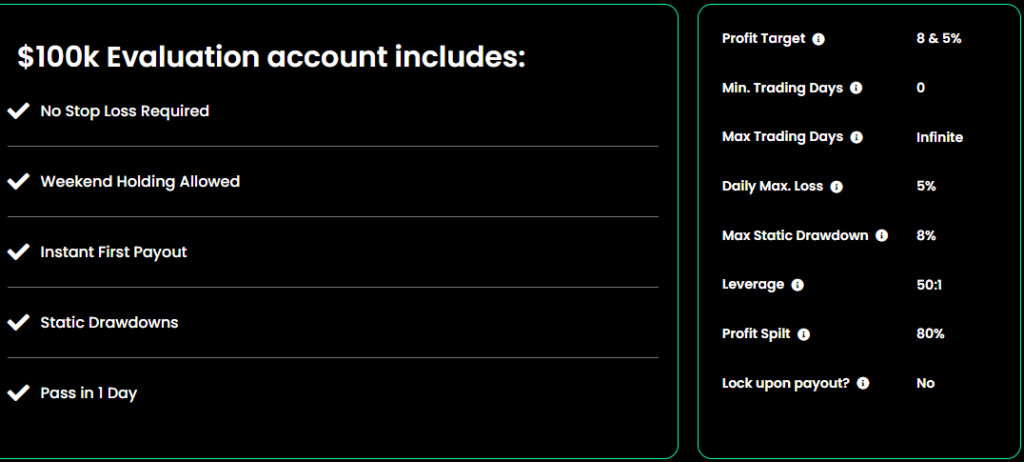
Tradexprop splits its evaluation into two phases. In Phase One, traders must achieve an 8% profit target while staying within a 5% maximum daily loss and 8% maximum loss.
There are no minimum or maximum trading-day requirements in this stage. That removes the pressure to manufacture trades simply to satisfy a calendar-based requirement. Traders can instead determine their own pace, provided they respect the account’s risk parameters.
Phase Two reduces the profit target to 5%, while retaining the 5% maximum daily loss and 8% maximum losslimits. Again, there is no minimum or maximum trading-day requirement.
Once both stages are completed, traders move to a funded account. The funded account continues to operate under the 5% maximum daily loss and 8% maximum loss rules, with no minimum withdrawal requirementstated in the program.
The Risk Rules Matter More Than the Profit Targets
The headline 8% and 5% targets are easy to focus on, but the loss structure is arguably more important from a trading-process perspective.
A 5% daily loss limit means traders cannot treat the evaluation as an open-ended attempt to recover losses. A poor session can quickly reduce the room available for subsequent trades. The 8% overall loss limit creates an even clearer boundary around risk-taking throughout the challenge.
That makes position sizing particularly important. A trader using the full 1:50 leverage available from Tradexprop still needs to distinguish between leverage capacity and sensible exposure. Higher leverage can increase flexibility, but it does not increase the amount that can be lost before the account breaches its rules.
No Trading-Day Requirement Changes the Strategy
One of the more practical features of the Tradexprop evaluation is the absence of minimum and maximum trading-day requirements.
This matters because some evaluation structures can encourage traders to spread activity across a prescribed number of days. Here, the trader does not need to trade simply because another qualifying day is required.
For a swing trader or someone who only takes setups under specific market conditions, that flexibility can be significant. It also potentially reduces the temptation to overtrade during quiet sessions or force entries that do not fit an established strategy.
At the same time, unlimited time should not be confused with unlimited risk. The account remains governed by its daily and overall drawdown limits, so waiting for better opportunities does not remove the need for disciplined risk management.
$5,000 to $400,000 Account Sizes Expand the Entry Range
Tradexprop offers account sizes from $5,000 through $400,000, giving traders multiple ways to approach the evaluation.
Smaller accounts can make the structure more approachable for traders who want to test their ability to operate within the firm’s rules without immediately selecting a large account. Larger account sizes, meanwhile, are more relevant to traders who already have a defined risk framework and want greater nominal trading capital.
The key consideration is that the account figure itself should not determine position size. The evaluation’s drawdown rules effectively define the amount of risk available to the trader, making the relationship between account size, stop-loss distance and position size more important than the headline funding amount.
What No Minimum Withdrawal Requirement Could Mean
The funded-account stage introduces another relevant feature: Tradexprop states that there is no minimum withdrawal requirement.
From a trader’s perspective, this changes the relationship between profitability and payout timing. Instead of needing to accumulate a specified minimum profit before becoming eligible to withdraw, the stated model does not impose such a minimum.
That can be particularly relevant to traders whose strategy generates smaller but repeatable gains rather than occasional large returns. However, traders should still review the firm’s complete payout terms and any other conditions governing withdrawals before treating the feature as a guarantee of a particular payout frequency or amount.
Tradexprop’s Model Rewards Patience, but Risk Still Comes First
The structure creates an interesting contrast. Traders have flexibility over when they trade, but relatively tight boundaries around how much they can lose.
That combination can favor a process-driven approach. A trader does not need to accelerate activity to meet a trading-day quota, while the two-stage target structure provides a defined progression toward funded status.
The psychological challenge is different. With an 8% target in Phase One and an 8% maximum loss, traders need to generate meaningful gains without allowing the pursuit of the target to push them toward oversized positions. Phase Two then lowers the target to 5%, potentially making the final stage feel less demanding, but the same loss limits remain in force.
What Traders Should Check Before Starting
The headline structure provides a useful overview, but traders should examine the full Tradexprop terms before purchasing an evaluation. Particular attention should go to trading restrictions, prohibited strategies, news trading rules, overnight and weekend positions, payout procedures, and any conditions that sit outside the headline drawdown rules.
That due diligence matters because an evaluation is not defined solely by its profit target. The operational rules determine whether a trader’s existing strategy can actually function within the account.
For traders who prefer flexible timing, defined drawdown limits and a progression-based funding model, the Tradexprop Two-Step Evaluation offers a structure worth examining. Its combination of $5,000–$400,000 account sizes, up to 1:50 leverage, no trading-day requirement and no minimum funded-account withdrawal requirement gives the program several practical points of interest.
Looking to reduce the cost of your evaluation? Check the latest Tradexprop review and our active discount code (FOREXPROPREVIEWS) available through Forex Prop Reviews before signing up.