


Blue Guardian Reserve is putting a low-cost entry point in front of futures traders, with 25K accounts starting at $48 and five-account bundles reducing the effective price to $41 per account. The Reserve model also gives traders control over key evaluation settings, including daily loss limits and consistency requirements.
That combination makes the latest pricing update more significant than a straightforward discount. For traders who already understand futures evaluations, the ability to customize the risk structure can matter just as much as the headline entry price.
Blue Guardian Reserve Drops 25K Entry Price to $48
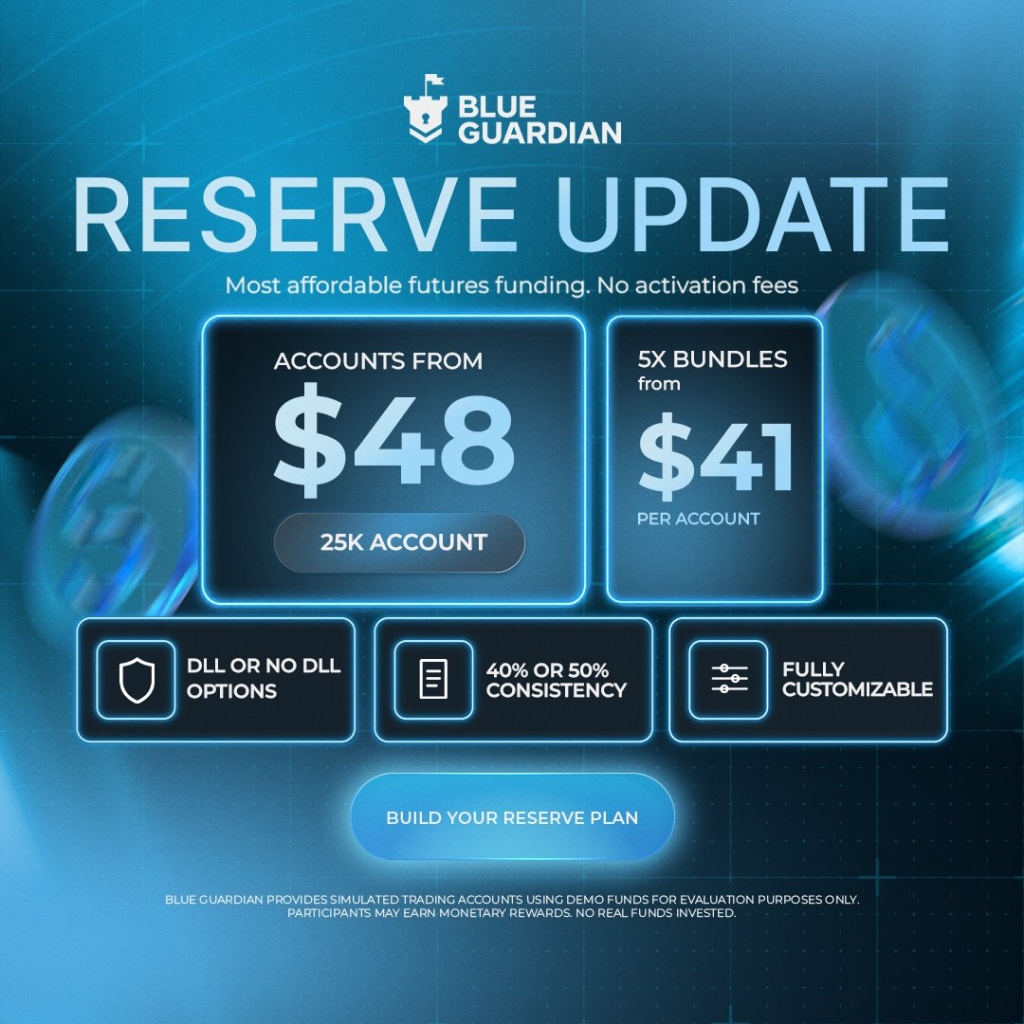
The latest Reserve promotion keeps the standard $48 price for a 25K account, while traders purchasing a 5x bundle pay $41 per account. There are also no activation fees, according to Blue Guardian’s announcement.
The firm currently offers Reserve accounts across $25K, $50K, $100K and $150K balances. The Reserve evaluation uses a one-phase structure with a 6% profit target and EOD trailing drawdown. The standard model has no daily loss limit, although Blue Guardian also offers a DLL option.
The bundle pricing is particularly relevant for traders who deliberately spread their evaluation attempts across multiple accounts. Five accounts at $41 each bring the total initial cost to $205, compared with $240 when purchasing five accounts at the $48 starting price.
Blue Guardian Reserve Puts More Weight on Customization
The most interesting part of the promotion may not be the $48 headline. Blue Guardian is also highlighting the ability to choose between DLL and no DLL, alongside 40% or 50% consistency options.
That gives traders an opportunity to align the evaluation with their own risk-management approach. A trader who prefers a hard daily guardrail may opt for DLL, while someone comfortable managing risk through the account’s overall drawdown may prefer the default no-DLL structure.
The consistency setting can also influence trading behavior. Consistency requirements are designed to prevent a trader from relying heavily on one unusually large winning session. Blue Guardian’s current Reserve documentation states that the 50% consistency requirement applies during the challenge, while funded Reserve accounts do not carry a consistency rule.
Low Entry Costs Can Change How Traders Approach Evaluations
The $41 bundle price introduces an interesting psychological element. When the cost of each individual evaluation falls, some traders may be more willing to run multiple accounts rather than repeatedly purchasing a single account after a failed attempt.
That can be useful when the accounts are separate, controlled trading experiments. It can also create the opposite problem: a low evaluation fee may encourage traders to take larger risks simply because replacing an account appears inexpensive.
For that reason, the lower entry price should not be confused with lower trading risk. The $25K Reserve account still carries a $1,000 maximum drawdown, while the profit target is $1,500. There is no daily loss limit by default, which gives traders flexibility but also places greater responsibility on position sizing and intraday risk control.
The Payout Structure Still Matters After Passing
The evaluation price is only one part of the Reserve equation. Once funded, traders receive a 90% profit split, while payouts require at least five qualifying winning days. For newer Reserve accounts, additional payout cycles also involve minimum net-profit requirements.
For a $25K account, Blue Guardian currently lists a $100 minimum winning-day threshold, a $500 net-profit requirement for applicable later payouts, and a payout cap of 50% of profits up to $1,000. Payout processing is stated at up to 24 business hours, with Rise and crypto available as withdrawal methods.
That structure makes the low evaluation price more useful for traders who have a realistic plan for reaching and maintaining funded status. Passing cheaply is one objective; building enough consistent profit to reach payout eligibility is another.
Blue Guardian’s Futures Strategy
The Reserve promotion also shows how Blue Guardian is differentiating its futures offering from a simple one-size-fits-all evaluation. Its current futures lineup includes multiple account models, while Reserve specifically targets traders looking for an EOD trailing drawdown and no daily loss limit by default.
For traders comparing funding programs, the practical question is therefore less about the advertised account balance and more about how the drawdown, consistency, payout and reset mechanics interact. A $25K account with a $1,000 drawdown behaves very differently from a conventional $25K cash account, regardless of the nominal balance.
The Reserve model can also be reset after a breach, although reset fees apply. This adds another cost consideration for traders evaluating whether the low initial purchase price actually fits their expected trading process.
What Traders Should Consider Before Buying
The new pricing makes Reserve accessible at a relatively low upfront cost, but traders should still read the complete rules before selecting their configuration. In particular, the choice between DLL and no DLL can materially change how a trader needs to manage intraday exposure.
The 40% versus 50% consistency choice also deserves attention. Traders whose strategies naturally produce uneven daily returns should understand how the selected threshold affects the evaluation before committing capital.
Blue Guardian’s broader offering includes multiple funding models, platforms and account structures, so Reserve is best viewed as one specific route into its futures ecosystem rather than simply a cheaper version of every other program.
For traders considering the promotion, the $41 five-account price is the most notable part of the update. It lowers the cost of running multiple Reserve evaluations, while the customizable rules give experienced traders more control over the structure they are entering.
Forex Prop Reviews readers can also use the code FOREXPROPREVIEWS for a discount on Blue Guardian funding programs. Check our Blue Guardian review for the firm’s broader account options, rules, payouts, and trading conditions.