
A Direct Funded Trader $9.99 Turbo Challenge gives traders a way to begin an evaluation without paying the full challenge fee upfront. Under the new Turbo model, traders pay just $9.99 to start, complete the challenge, and only pay the remaining evaluation fee after successfully passing.
That payment structure makes the promotion more than a simple price reduction. It moves the larger financial commitment to a later stage of the evaluation, giving traders an opportunity to demonstrate their performance before paying the full fee.
Direct Funded Trader Launches $9.99 Turbo Challenge
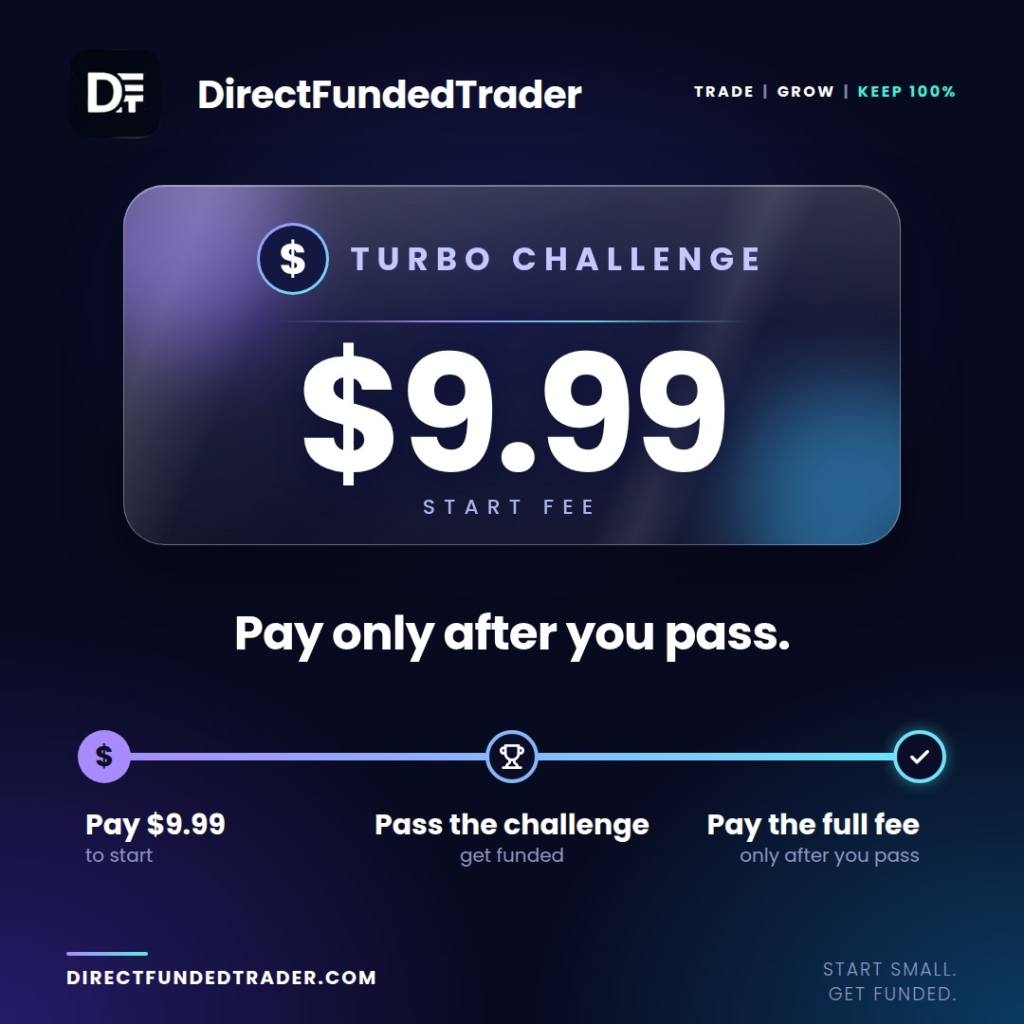
Direct Funded Trader has introduced its new Turbo Challenge, advertised with a $9.99 start fee. The firm’s promotional graphic lays out the process in three stages: pay $9.99 to begin, pass the challenge, and then pay the full fee. The official website describes the same model as “pay after you pass.”
This distinction matters. The $9.99 should not be interpreted as the complete cost of obtaining the account. Instead, it functions as the initial payment required to access the evaluation, with the larger challenge fee deferred until the trader passes.
The Turbo configuration currently displayed by Direct Funded Trader includes account balances ranging from $15,000 to $200,000. The firm’s configuration page also shows weekly, bi-weekly, and monthly payout options, with corresponding profit shares of 70%, 80%, and 100%.
Why the $9.99 Start Fee Matters
The most interesting part of the Turbo Challenge is the change in payment timing. In a conventional evaluation, a trader commits the entire challenge fee before knowing whether they can complete the firm’s objectives. Direct Funded Trader’s model delays that larger payment until after the evaluation has been passed.
For traders, that reduces the amount of money required to begin testing a strategy under the firm’s rules. It also changes the psychological relationship with the evaluation: instead of immediately trying to protect a larger upfront fee, the trader starts with a much smaller initial commitment.
There is another side to that equation. A $9.99 entry cost can make an evaluation feel inexpensive enough to repeat casually. Traders still need to approach the account as a risk-management exercise rather than treating the low starting fee as permission to increase position sizes or take trades outside their normal strategy.
Challenge Rules Remain More Important Than the Entry Price
The low start fee does not remove the need to examine the underlying evaluation conditions. Direct Funded Trader’s Turbo configuration currently lists a 6% Phase 1 profit target, a 3% maximum daily loss, an 8% maximum overall loss, a two-day minimum trading requirement and 1:100 leverage.
Those parameters should be considered alongside the $9.99 entry point. A trader who focuses exclusively on the headline price could overlook the fact that passing still requires meeting specific performance and risk limits.
The payment model therefore works best for traders who already understand their own risk profile. The smaller initial payment lowers the financial barrier to starting, but it does not change the trading discipline required to reach the funded stage.
A Different Prop Trading Payment Model
There is a broader operational reason why the Turbo structure stands out. Prop firms generally collect evaluation fees before traders enter the challenge. Direct Funded Trader’s approach places the larger payment after successful completion, effectively linking the main fee commitment to a demonstrated evaluation result.
That can make the offer particularly relevant to traders who are hesitant to commit to a full evaluation fee before testing the firm’s environment. It also creates a clearer separation between access cost and full challenge cost.
The model could also influence conversion behaviour. A trader who might otherwise abandon an evaluation because of the initial price may be more willing to begin with $9.99. At the same time, the deferred fee means traders need to know exactly how much they will owe after passing before entering the challenge.
What Traders Should Check Before Entering
The most important figure is therefore not simply the $9.99 start fee. Traders should review the full amount payable after passing and confirm that the final cost fits their budget.
The specific Turbo rules should also be checked before trading, including the profit target, daily loss limit, maximum loss, minimum trading days, payout structure, and trading platform. Direct Funded Trader’s current Turbo configuration provides these details during account selection.
The firm’s broader offering includes evaluation and Fast Funding programs, with Forex Prop Reviews currently listing account sizes up to $200,000, leverage up to 1:100, and multiple trading instruments. Its FPR review also lists a 60% discount code, FOREXPROPREVIEWS, for its account offerings.
Direct Funded Trader Puts the Upfront Cost on Hold
The Turbo Challenge is ultimately built around a simple proposition: start small, prove yourself, then pay the full evaluation fee. That is materially different from presenting $9.99 as the total price of the challenge.
For traders, the attraction lies in the reduced initial commitment. The important consideration is what happens after passing and whether the complete Turbo structure, including its targets, drawdown limits and payout conditions, fits the trader’s approach.
The offer therefore deserves attention less because of the $9.99 figure alone and more because of the deferred-payment mechanism behind it. Direct Funded Trader is effectively moving the larger financial decision further along the evaluation process, when the trader has already demonstrated performance.
Direct Funded Trader Discount Code
Want to explore the Turbo Challenge? Forex Prop Reviews currently offers a 60% discount code: FOREXPROPREVIEWS for Direct Funded Trader. Check the full review for the firm’s funding programs, trading rules, account sizes, and current offer before signing up.