

The PropXP Two-Step Challenge gives traders access to account sizes from $3,000 to $200,000, combining a conventional two-phase evaluation with no maximum trading period. That structure removes one of the most common sources of pressure in prop trading: the need to reach a profit target before a fixed deadline.
For traders, the more important consideration is how the account’s risk limits interact with the 40% consistency rule and the payout system. Rather than simply rewarding traders who can hit a target quickly, the model places greater emphasis on producing profits within defined risk parameters and maintaining a consistent trading profile.
How the PropXP Two-Step Challenge Works
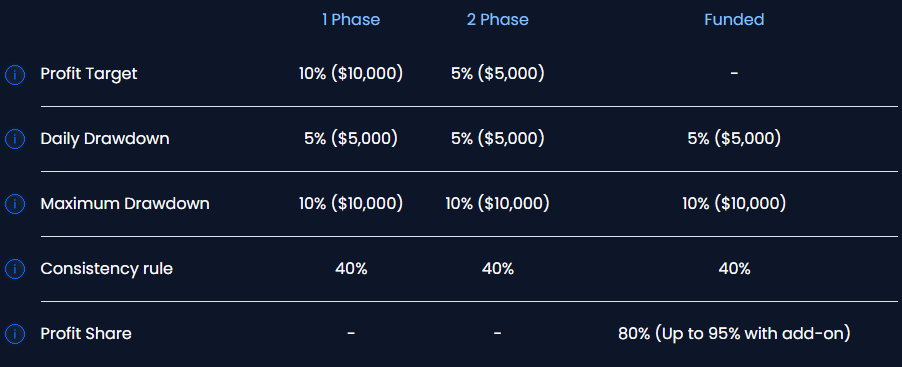
The evaluation is divided into two phases, with different profit targets but the same core drawdown limits.
In Phase One, traders must reach a 10% profit target, while keeping maximum daily losses below 5% and maximum overall losses below 10%. There is no maximum number of trading days, giving traders room to adapt their pace to their strategy rather than increasing position sizes simply to finish the challenge faster.
Phase Two reduces the profit target to 5% while retaining the 5% maximum daily loss and 10% maximum overall loss limits. The absence of a maximum trading period remains in place, so traders who prefer a slower approach do not face the same deadline pressure found in many evaluation models.
There is no formal minimum trading-day requirement, but the 40% consistency rule still affects how traders can approach the evaluation. In practical terms, this makes concentrated one-day performance less useful and encourages traders to distribute their results across multiple trading sessions.
Risk Limits Matter More Than the Headline Account Size
The availability of a $200,000 account is naturally one of the most visible features of the program, but experienced prop traders will usually look beyond the headline balance.
The critical numbers are the 5% daily loss limit and 10% maximum overall loss. These determine how much room a trader actually has to absorb losing trades, normal market volatility and periods of drawdown.
Leverage also differs depending on the stage. PropXP provides up to 1:100 leverage during both challenge phases, falling to up to 1:50 on the funded account. The reduction is worth noting because leverage can materially change how traders structure positions, particularly around volatile instruments.
The higher challenge leverage may provide more flexibility for execution, but it does not increase the permitted drawdown. Traders still need to size positions around the account’s loss limits rather than treating available leverage as a target for exposure.
The 40% Consistency Rule Changes the Strategy
The consistency requirement is one of the more operationally significant parts of this funding program.
A trader who reaches a target through one unusually large winning session may have a different risk profile from someone who builds profits steadily. The 40% consistency rule limits the extent to which results can be concentrated, making the path to completion more important than simply reaching the required percentage.
This can also influence trader psychology. Without a maximum trading period, there is less reason to accelerate trading purely because a deadline is approaching. That combination gives traders the opportunity to wait for setups instead of manufacturing opportunities to meet a time constraint.
For traders who naturally rely on high-conviction setups, however, the consistency requirement needs to be considered before entering the challenge. A strategy that produces most of its gains from occasional outsized trades may require adjustment to fit the account model.
PropXP’s Funded Account Adds Payout Flexibility
Once both evaluation stages are complete, traders move to a funded account under the applicable risk rules.
The standard profit split is 80%, while an optional add-on can increase the trader’s share to 95%. The payout structure is particularly notable because the first payout can be available on demand, rather than requiring traders to wait through a fixed initial payout cycle.
After that, payouts can generally be available every 14 calendar days. Traders who activate the payout add-on can reduce that interval to 7 calendar days, creating a meaningful difference for traders whose priority is more frequent access to profits.
There is also an unusual payout incentive: if an approved payout is delayed beyond one business day, the trader qualifies for a 100% profit split on that payout request. This does not change the standard profit split for other withdrawals, but it creates a specific financial protection around delayed approved payouts.
No Time Limit Can Change Trader Behavior
The absence of a maximum trading period is arguably more important than it first appears.
Time-limited evaluations can encourage traders to increase frequency or risk after a slow start. That behavior is especially problematic when a trader is already operating close to the daily or overall loss threshold. PropXP’s unlimited evaluation period removes that particular deadline-driven pressure.
It does not make the challenge easy. The 10% Phase One target, 5% Phase Two target, drawdown restrictions and consistency rule still determine whether an account survives. What changes is the decision-making environment: traders can potentially allow their strategy to develop over a longer period rather than treating the evaluation as a race.
That distinction may make the structure more suitable for swing-oriented or lower-frequency traders, provided their strategies remain compatible with the firm’s trading conditions and applicable rules.
Account Sizes Range From $3K to $200K
The account-size range gives traders several entry points rather than forcing every participant into a single capital bracket.
Smaller accounts can provide a lower-scale way to test whether a trader’s strategy fits the evaluation rules, while larger accounts are designed for traders seeking greater nominal capital allocation. However, the larger account balance should not be confused with proportionally greater tolerance for poor risk management.
Because the maximum loss percentages remain central to the model, traders should assess the account according to its permitted drawdown rather than focusing only on the advertised balance.
That is particularly relevant when comparing funding programs. A $200,000 account may sound substantially different from a smaller evaluation, but the practical question is how the account’s loss limits, profit targets, consistency conditions and payout rules interact with the trader’s strategy.
What Traders Should Consider Before Choosing PropXP
The PropXP model is most interesting for traders who value flexibility over speed.
The lack of a maximum trading period reduces deadline pressure, while the consistency requirement discourages an approach built around a single large winning day. The combination therefore favors traders who can maintain controlled exposure and build returns progressively.
Payout terms add another layer. The standard 80% profit split is straightforward, while the optional 95% split, weekly payout option and delayed-payout protection give traders several ways to prioritize either a higher share of profits or faster access to withdrawals.
The trade-off is that additional features and add-ons need to be evaluated against their cost. Traders should calculate whether a higher profit split or more frequent payouts actually improves their expected economics based on their anticipated payout frequency and profitability, rather than selecting an add-on simply because the headline percentage is higher.
PropXP’s Two-Step Model Takes a Flexible Approach
PropXP’s Two-Step Challenge stands out less because of a single unusually aggressive feature and more because several rules work together. No maximum trading period, a 10%/5% two-phase target structure, 5% daily and 10% overall loss limits, and a 40% consistency rule create a model that rewards controlled progression rather than rushed evaluation attempts.
For funded traders, the 80% standard profit split, optional 95% split, on-demand first payout and subsequent 14-day payout cycle provide a relatively flexible withdrawal framework.
Traders considering the program should therefore evaluate more than the account size. The real question is whether their trading frequency, position sizing and profit distribution can operate comfortably within the challenge rules and remain sustainable after funding.
Forex Prop Reviews readers can use the FOREXPROPREVIEWS discount code when signing up for PropXP. Traders can review the firm’s program details before choosing an account size and challenge structure by clicking HERE.