

OFP Two-Phase Evaluation gives traders a structured route to funded status with account sizes from $10,000 to $200,000, leverage of up to 1:100, and relatively wide drawdown limits. For traders who prefer proving consistency through a staged evaluation rather than paying for instant funding, the model offers a more traditional route into OFP’s funding ecosystem.
The evaluation requires traders to make 8% in Phase One and 4% in Phase Two, while staying within a 5% maximum daily loss and 10% maximum overall loss in both stages. Each phase also requires at least five trading days, making the program less suited to traders looking to complete an evaluation in a handful of aggressive sessions.
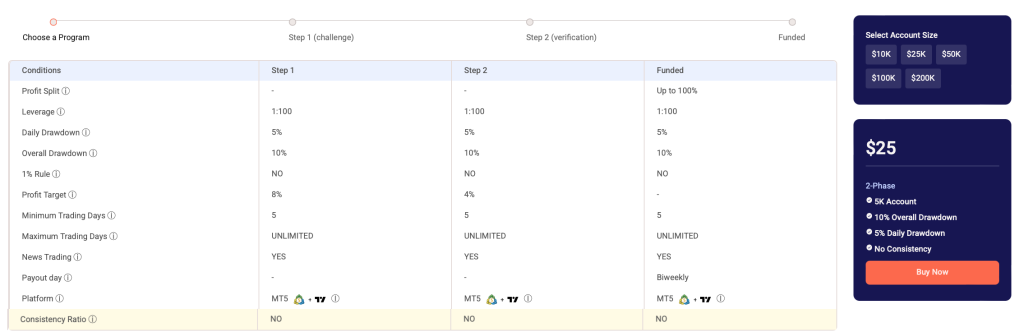
OFP Two-Phase Evaluation Rules
The structure is straightforward, but the difference between the two phases matters.
Phase One requires an 8% profit target. Traders must also respect the 5% daily loss and 10% maximum loss limits and complete at least five trading days before progressing.
Phase Two lowers the target to 4%, while keeping the same 5% daily and 10% overall loss limits. A minimum of five trading days applies again.
Once both phases are completed, the trader moves to a funded account. According to the available program information, the funded stage does not introduce another profit target, although traders must continue respecting the applicable drawdown rules and minimum trading-day requirement.
The account sizes currently listed for the Two-Phase Evaluation are:
| Account Size | Price |
| $10,000 | $42 |
| $25,000 | $70 |
| $50,000 | $140 |
| $100,000 | $210 |
| $200,000 | $385 |
The relatively low entry price at the smaller account levels makes the program accessible to traders who want to test a two-step model without immediately committing to a larger evaluation.
Why the 5% Daily and 10% Overall Limits Matter
The drawdown structure is arguably one of the more important aspects of the program.
A 5% daily loss limit gives traders more room than tighter evaluation models that force participants to operate around a 3% daily threshold. That additional headroom can be useful for strategies that experience normal intraday fluctuations, although it should not be interpreted as a reason to risk 5% in a single session.
The 10% overall loss limit also creates a substantial buffer between the starting balance and account failure. In practical terms, traders have more room to absorb losing trades while pursuing the profit targets.
That changes the psychology of the evaluation. The 8% target in Phase One can be approached through smaller, repeatable gains rather than requiring a trader to take oversized positions simply to finish quickly. For disciplined traders, the wider drawdown allowance may reduce the temptation to treat the challenge like a short-term sprint.
Phase Two Changes the Risk-Reward Equation
The second stage is where the structure becomes more interesting.
After reaching 8% in Phase One, traders only need another 4% to complete Phase Two. The loss parameters do not tighten during this stage, so the target becomes materially smaller relative to the permitted drawdown.
That creates a different trading environment. A trader who has already demonstrated the ability to reach the first target does not need to reproduce the same level of performance in Phase Two.
The danger is complacency.
Passing Phase One can create a psychological tendency to accelerate in the second stage because the finish line appears closer. Yet with only 4% remaining, forcing trades after a losing session may be unnecessary. The more rational approach is arguably to preserve the account and let the lower target work in the trader’s favor.
Five Minimum Trading Days Can Influence Strategy
The five-day minimum in each phase is another operational detail traders should account for before purchasing the evaluation.
A trader could theoretically reach the profit target quickly but still need additional qualifying trading days. That means the program rewards traders who plan around the rules rather than simply chasing the headline target.
For swing traders, the requirement may be relatively easy to accommodate if positions naturally remain open across multiple sessions. Short-term traders, meanwhile, should avoid manufacturing trades purely to satisfy the minimum-day condition.
This is an important distinction in evaluation programs: a minimum trading-day rule can influence behavior even when it does not directly affect profitability.
OFP’s Broader Funding Model
The Two-Phase Evaluation is only one route within OFP’s wider funding offering. The firm also provides instant funding and a One-Phase Evaluation, giving traders several ways to access its simulated funding programs. OFP currently highlights both challenge-based and instant funding models, with profit splits of up to 100% depending on the program and account conditions.
That variety is strategically significant. Traders do not all want the same progression model: some prefer paying less for an evaluation and proving their strategy first, while others would rather bypass profit targets altogether through an instant funding account.
The Two-Phase option therefore serves a specific segment of OFP’s customer base: traders comfortable with evaluation requirements who want comparatively broad drawdown parameters and a lower second-stage target.
Payout Structure Adds Another Incentive
The funding stage is where the evaluation structure becomes commercially relevant for traders. OFP states that its Two-Phase funded accounts can offer up to 100% profit split, with payouts available on a bi-weekly basis after the applicable conditions are met.
That payout schedule can influence trader behavior. Once an evaluation has been completed, the incentive shifts away from hitting another qualification target and toward protecting profits long enough to reach a withdrawal opportunity.
For traders, this makes the evaluation only half of the decision. The more important question is whether the funded-stage rules fit their normal trading behavior. A challenge can look attractive on its headline targets while becoming less suitable if the trader’s strategy conflicts with payout or risk-management conditions.
How the Two-Phase Model Fits OFP
OFP has positioned itself around several different funding routes rather than relying exclusively on a traditional challenge. Its current offering includes instant funding alongside one- and two-phase evaluation structures, while the firm also promotes flexible payout arrangements and scaling opportunities.
The Two-Phase Evaluation makes sense within that ecosystem because it gives traders a conventional progression route without using an especially compressed target in the second stage.
For traders comparing prop firm challenges, the practical takeaway is to look beyond the advertised account size. The relevant variables are the relationship between the profit target, daily drawdown, overall drawdown, minimum trading days, and funded-stage payout rules.
Is OFP’s Two-Phase Evaluation Worth Considering?
The program is most likely to appeal to traders who prefer a two-stage evaluation with a 5% daily loss limit and 10% overall loss limit rather than a tighter drawdown structure.
The 8% first target requires meaningful performance, but the subsequent 4% target gives successful Phase One traders a less demanding second hurdle. The five-day minimum in each phase is manageable for most traders who already follow a structured trading routine, although it means the evaluation cannot simply be treated as a one- or two-day target challenge.
The main advantage is therefore not simply the account size. It is the combination of moderate profit targets, relatively wide drawdown parameters, and a funded stage that can provide up to 100% profit split.
Traders should still review the complete rules before purchasing, particularly because prop firm programs can change and the conditions applying to one OFP account type may not apply to another.
Conclusion
OFP’s Two-Phase Evaluation offers a fairly clear progression: 8% in Phase One, 4% in Phase Two, five minimum trading days per phase, 5% daily loss and 10% maximum loss.
Its structure favors traders who can generate steady returns without needing to push aggressively for a rapid pass. The biggest mistake would be treating the 10% maximum loss as usable risk capital; the real objective is to reach each target while preserving enough account flexibility to handle normal losing periods.
For traders already comfortable with evaluation-based funding, the Two-Phase model is worth comparing against OFP’s other account options, particularly because the firm offers multiple routes toward funded status rather than forcing every trader into the same challenge structure.
Forex Prop Reviews readers can use the code FOREXPROPREVIEWS for 25% off OFP funding programs.Before purchasing, check our latest OFP review for the firm’s current rules, payout structure, account options, and overall assessment.