


OFP One-Phase Challenge offers traders a direct route to funded trading through a single evaluation, with account sizes ranging from $5,000 to $200,000. The OFP One-Phase Challenge combines an 8% profit target with a 3% maximum daily loss and a 6% maximum overall loss, making risk management just as important as reaching the target. Its early payout eligibility and profit split of up to 100% also give traders practical reasons to examine how the program fits their trading strategy.
Rather than requiring traders to pass multiple evaluation stages, OFP keeps the qualification process to one phase. However, the relatively tight drawdown limits mean that the appeal of a shorter evaluation depends on whether traders can produce consistent results without exposing their accounts to excessive risk.
OFP One-Phase Challenge: Account Sizes and Rules
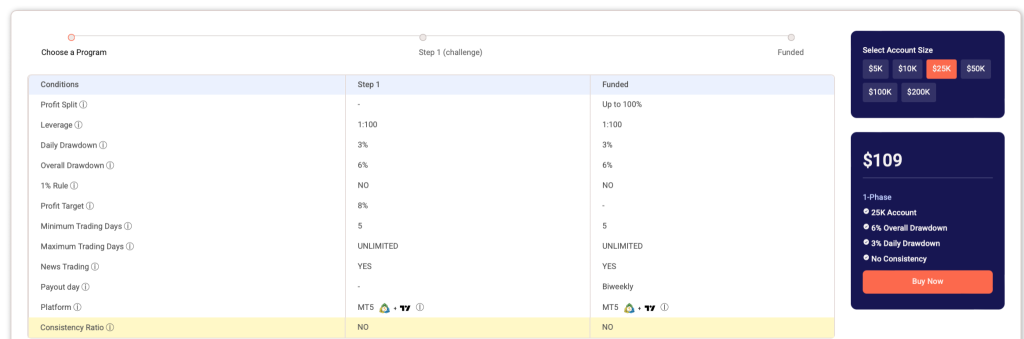
The program provides account options from $5,000 to $200,000, allowing traders to select a starting balance that matches their strategy, experience, and risk tolerance. Leverage reaches 1:100 during the evaluation, offering flexibility in position sizing while making disciplined exposure management essential.
The main evaluation requirements are:
- Profit target: 8%
- Maximum daily loss: 3%
- Maximum overall loss: 6%
- Minimum trading days: 5
- Evaluation stages: One
- Maximum advertised leverage: 1:100
Traders must achieve the 8% target without violating either loss limit and complete the five minimum trading days. Reaching the profit target alone is not sufficient if a drawdown breach occurs during the process.
The single-stage structure removes the need to qualify through a second evaluation phase. That can simplify planning for traders who already have a tested strategy, although it does not eliminate the difficulty of operating within the drawdown restrictions.
How the 3% Daily Loss Limit Shapes Trading Decisions
The 3% daily loss limit is one of the most consequential features of the OFP funding model. While the 8% target provides a clear objective, the daily restriction can limit how aggressively traders recover from losing positions or respond to unfavorable market conditions.
For example, a trader pursuing the target through oversized positions may reach a point where a short sequence of losses threatens the account before the strategy has enough time to recover. A more measured approach, with predetermined risk per trade and a daily stop-trading threshold below the firm’s maximum, can help preserve room for normal fluctuations.
The 6% maximum overall loss adds another layer of discipline. Traders need to manage cumulative drawdown throughout the evaluation rather than focusing exclusively on daily performance. The practical challenge is to make progress toward the target without allowing a few unsuccessful trades to consume too much of the available risk budget.
The five-day minimum trading requirement also matters. Traders cannot assume that a strong result achieved in a single session will automatically complete the evaluation. They need to plan for the minimum number of trading days while avoiding unnecessary trades purely to satisfy the requirement.
Funded Account Payouts and the Potential for a 100% Profit Split
OFP’s payout structure is a notable part of the offer. According to the program details, traders who complete the evaluation receive a funded account and must continue respecting the 3% daily loss and 6% overall loss limits.
The firm advertises a first payout as early as day one, provided the trader generates profit. Subsequent withdrawals can be submitted on a bi-weekly basis, while the profit split can reach 100%, depending on the applicable terms.
Early payout eligibility can influence how traders approach a funding program. Instead of waiting through a lengthy initial payout cycle, eligible traders may be able to access profits sooner. That can make the program attractive to traders who prioritize payout timing alongside account size and evaluation requirements.
However, the distinction between being eligible to request a payout and receiving an approved, processed payment is important. Traders should verify the conditions governing the first withdrawal, including any minimum profit, account activation, processing, or other applicable requirements. They should also confirm how the advertised 100% profit split is determined rather than assuming it applies unconditionally to every account and withdrawal.
The bi-weekly withdrawal schedule for subsequent payouts provides a recurring opportunity to access profits. For traders who prefer to withdraw earnings regularly instead of leaving them in the account, this may be a meaningful consideration when comparing funding programs.
Why a Single Evaluation Phase May Suit Experienced Traders
A one-phase evaluation can appeal to traders who want a straightforward qualification process. There is no second evaluation target to plan around, and the path to funded status depends on meeting the stated requirements in one stage.
That simplicity may be particularly useful for traders whose strategies already have defined entry criteria, position-sizing rules, and drawdown controls. They can focus on executing their existing process rather than adjusting to different targets across multiple phases.
The structure is less forgiving for traders who rely on inconsistent bursts of performance. An 8% target paired with a 6% maximum overall loss leaves limited room for substantial drawdowns, especially if a trader increases position sizes after losing trades. A single evaluation reduces procedural complexity, but it does not necessarily reduce the underlying trading challenge.
Account selection deserves similar attention. Although the $200,000 option may look attractive, the largest available balance is not automatically the best choice. Traders should assess the firm’s exact loss calculations, applicable account terms, and their own ability to follow the rules before deciding which account size offers the most practical starting point.
What Traders Should Check Before Choosing OFP
Before purchasing the OFP One-Phase Challenge, traders should review the complete program terms rather than evaluating the offer solely by its profit target or maximum account size.
First, confirm how the daily and overall loss limits are calculated, including whether they use equity or balance and how floating losses, commissions, and swaps affect compliance. These details can materially change the amount of risk available during volatile market conditions.
Second, review the conditions attached to funded-account payouts and the advertised profit split. The timing of the first withdrawal, the requirements for later withdrawals, and the precise circumstances in which a 100% split applies should all be clear before committing to an evaluation fee.
Finally, compare the challenge price with the rules and payout conditions, not just the headline account balance. A large nominal account can be less useful than a smaller account if its risk limits do not suit the trader’s strategy. Pricing, refund or reward conditions, and any additional restrictions should be considered together when assessing the program’s overall value.
Is OFP’s One-Phase Funding Model Worth Considering?
OFP’s One-Phase Challenge brings together a single evaluation stage, account sizes up to $200,000, leverage of up to 1:100 during evaluation, and a profit split advertised at up to 100%. Its first-day payout eligibility is another feature worth examining for traders who place a premium on accessing profits quickly.
The key trade-off is the relationship between the 8% target and the 3% daily and 6% overall loss limits. Traders with disciplined risk management and a strategy designed to operate within those boundaries may find the streamlined evaluation appealing. Those who need substantial drawdown room or frequently change their trading approach should pay particular attention to the restrictions before choosing an account.
For traders comparing one-step funding programs, OFP is worth assessing on the combined merits of its evaluation rules, account pricing, and payout terms rather than account size alone.
For more details, visit Forex Prop Reviews’ OFP review and check the available offer using the discount code (FOREXPROPREVIEWS) provided by FPR Offers.