


The Moneta Funded Phoenix Account is designed for traders who want immediate access to funded capital without navigating a traditional evaluation process. Rather than focusing on profit targets before funding, this model allows traders to begin trading from day one while working within clearly defined risk parameters. For traders who prefer execution over evaluation, it represents a different approach to entering the funded trading space.
Instead of passing a challenge first, traders purchase instant access to funded accounts ranging from $2,500 to $20,000. The account combines immediate payout eligibility with a structured scaling plan, creating an option that rewards disciplined performance over time rather than short-term target chasing.
How the Moneta Funded Phoenix Account Works
The Phoenix Account operates as an Instant Funding model, eliminating the evaluation phase commonly found across the prop trading industry. Traders receive access to funded capital immediately and can begin generating profits without first meeting a profit objective.
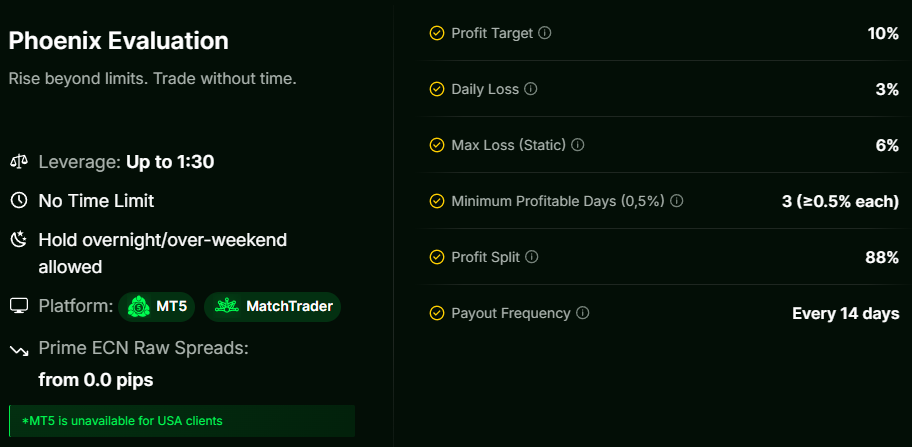
Account sizes range from $2,500 to $20,000, while leverage is at 1:30, encouraging measured position sizing instead of excessive risk-taking. Although leverage is lower than many challenge accounts, it aligns with the account’s emphasis on long-term capital preservation.
Perhaps the most notable feature is that there is no profit target required before requesting a payout. Instead, traders become eligible for withdrawals after completing the account’s payout conditions, including a 14-day trading period, three profitable trading days, and a minimum withdrawal amount of $100.
A Different Philosophy Than Evaluation Challenges
Most prop firms still rely on evaluation programs where traders must reach fixed profit objectives before gaining access to funded capital. While those models reward profitable trading, they can also influence trader behavior by encouraging aggressive risk-taking as traders attempt to hit performance targets within a limited timeframe.
The Phoenix Account removes that incentive. Since withdrawals are not tied to reaching a predefined profit percentage, traders can focus on executing their existing trading plan rather than adapting their strategy simply to pass an evaluation.
This distinction matters operationally. Removing the evaluation stage shifts attention toward consistency and risk control, two factors that often determine long-term success far more than isolated high-return periods.
Risk Rules Still Define Success
Immediate funding does not mean unrestricted trading.
The account maintains a 3% maximum daily loss and 6% maximum overall loss, providing clear boundaries that traders must respect throughout the account’s lifecycle. It also uses a static drawdown model, making risk calculations easier compared with more complex trailing drawdown structures used elsewhere in the market.
For experienced traders, static drawdown often creates greater planning certainty. Knowing exactly where the account limits remain allows position sizing and portfolio risk to remain consistent instead of constantly adjusting to a moving loss threshold.
Scaling Creates the Long-Term Opportunity
Although payouts do not require a profit target, the Phoenix Account still incorporates growth incentives through its scaling system.
A 10% profit target applies only when qualifying for account scaling rather than unlocking withdrawals. This distinction separates income generation from account progression, allowing traders to focus on regular payouts while still working toward larger capital allocations.
Successful traders can ultimately scale their buying power to $2 million, creating a clear long-term progression path without forcing every trading decision around evaluation milestones.
Why This Structure May Appeal to Certain Traders
Instant funding continues gaining popularity because many experienced traders believe their edge is already proven and prefer allocating capital toward live performance rather than repeated evaluation attempts.
The Phoenix Account reflects that demand by simplifying the route to funded trading while maintaining professional risk controls. Instead of rewarding traders for reaching a single performance milestone, the model emphasizes sustained account management through drawdown discipline, profitable trading activity, and consistent participation.
That balance may particularly suit traders who already have an established strategy but dislike altering their risk profile simply to satisfy evaluation objectives.
Positioning Within Today’s Prop Firm Market
As the prop trading industry becomes increasingly competitive, firms are differentiating themselves through account structures rather than simply offering larger account sizes or higher leverage.
Programs like the Phoenix Account demonstrate this shift. Rather than competing solely on pricing, they focus on reducing friction between account purchase and earning potential while keeping meaningful safeguards in place. The result is an offering that sits somewhere between traditional proprietary funding and direct capital allocation, appealing to traders who value operational simplicity alongside structured risk management.
Conclusion
The Moneta Funded Phoenix Account is less about removing discipline and more about changing where that discipline is. Instead of proving profitability before funding, traders must demonstrate consistency while already managing funded capital under predefined risk limits.
For traders comfortable operating within static drawdown rules, the combination of instant funding, an 88% profit split, early payout eligibility, and a structured scaling roadmap offers an alternative to conventional evaluation models without abandoning responsible risk management.
Looking to reduce your purchase cost? Forex Prop Reviews partners with Moneta Funded to provide an exclusive discount code (FOREXPROPREVIEWS) for eligible accounts. Before purchasing, visit our Moneta Funded review to compare account types, review the latest rules, and access the current promotional offer available through Forex Prop Reviews.