



The Leveraged Classic One-step Challenge gives traders a relatively straightforward route toward a funded account, with a $5,000 account size, a single evaluation phase, and no maximum time limit. The model is built around a demanding 10% profit objective, while the 3% daily loss and 6% maximum loss limits place clear boundaries around how much risk traders can take.
For traders who prefer to develop a position gradually rather than chase an evaluation deadline, the absence of a maximum trading period is arguably the most practical feature. At the same time, the 10% target means the challenge is not simply an easy-access entry point; traders still need a strategy capable of generating substantial returns without getting close to the drawdown limits.
How the Leveraged Classic One-Step Challenge Works
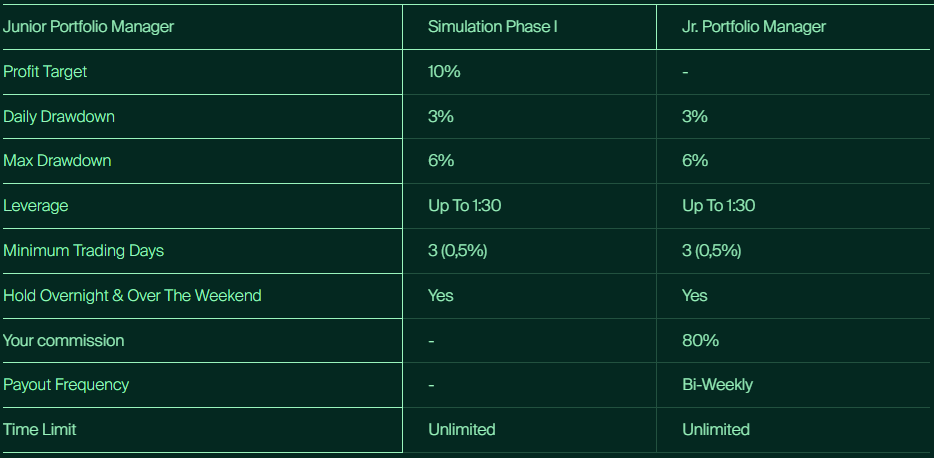
The Classic One-step Challenge provides traders with a $5,000 account and leverage of up to 1:30.
During the evaluation, traders must reach a 10% profit target, equivalent to $500 on a $5,000 account. The account has a 3% maximum daily loss and 6% maximum loss limit.
There are no minimum or maximum trading-day requirements during the evaluation. This gives traders flexibility to complete the target according to their strategy rather than being forced to trade within a predetermined timeframe.
After completing the evaluation without breaching the loss limits, traders move to the funded stage. The funded account maintains the 3% daily loss and 6% maximum loss rules, while introducing a requirement of at least three profitable trading days.
The 10% Target Is the Real Filter
The one-step format removes one major obstacle found in traditional multi-stage evaluations: there is only one phase to complete. But that does not make the program low-pressure.
A 10% profit target against a 6% maximum loss creates a relatively demanding risk-to-reward environment. A trader cannot simply rely on a few oversized positions to get through the challenge without materially increasing the probability of breaching the account.
This is where the unlimited evaluation period becomes important. A trader using a lower-frequency swing or position-based strategy can spread the required return across more market opportunities instead of compressing performance into a fixed number of weeks.
The absence of a maximum trading period also changes the psychology of the evaluation. There is less reason to manufacture trades during quiet markets, which can be particularly useful for traders whose strategies depend on specific volatility conditions.
What Happens After Passing?
The funded stage introduces a different set of considerations. Traders must record at least three profitable trading daysbefore becoming eligible for withdrawals.
The absence of a minimum withdrawal requirement is another notable feature. Traders are not required to accumulate a particular dollar amount before requesting a payout, which can make the funded stage more flexible for traders who prefer taking smaller, regular profits.
This is important because the economics of a prop challenge do not end when the evaluation is passed. A trader who reaches funded status but cannot withdraw until reaching a substantial threshold has a different experience from one who can access profits without such a barrier.
No Maximum Time Limit Changes the Trading Approach
Many evaluation models indirectly encourage speed because traders face a deadline. That can create a counterproductive feedback loop: a trader falls behind the target, increases risk, experiences a losing trade, and then feels pressure to recover the deficit quickly.
The Leveraged Classic One-step Challenge removes that specific pressure by allowing unlimited time during the evaluation. The trader can therefore treat the 10% target as a performance objective rather than a race.
That does not eliminate risk. The relatively tight 3% daily loss limit means traders still need disciplined position sizing. However, the structure favors those who can wait for their setups and may be less suitable for strategies that depend on repeatedly taking large positions to hit short-term targets.
A Small Account With a Clear Risk Framework
The $5,000 account also positions the program differently from larger funding challenges. The lower nominal account size makes the program more accessible, but traders should avoid interpreting the account figure as personal trading capital.
The practical risk boundaries are the $150 daily loss limit and approximately $300 maximum loss, assuming the percentage rules are applied to the $5,000 starting balance.
Leverage of up to 1:30 provides sufficient exposure for many forex strategies, but traders do not need to use the maximum available leverage. In an evaluation with a 6% maximum loss, controlling exposure can be more valuable than maximizing buying power.
Where the Program Fits in the Prop Firm Landscape
The Classic One-step Challenge sits within Leveraged’s broader range of funding programs. The one-step structure is particularly relevant for traders who want to avoid completing a second evaluation phase while maintaining clearly defined drawdown limits.
Its 1:30 leverage also places the program toward the more moderate end of prop-firm leverage structures. Higher leverage can increase flexibility, but it can also make it easier for traders to take positions that are disproportionately large relative to their allowable drawdown.
For that reason, traders should evaluate leverage alongside the loss limits rather than treating a higher leverage figure as an automatic advantage.
The Main Trade-Offs Traders Should Consider
The strongest feature of the program is the combination of one evaluation phase and unlimited evaluation time. Traders can focus on completing the target without worrying about an arbitrary maximum duration.
The main challenge is the 10% target relative to the 6% maximum loss. Traders who regularly rely on high-risk, high-frequency approaches may find the structure less forgiving than the account size initially suggests.
The funded-stage requirements also deserve attention. The three profitable trading days mean that passing the evaluation is only one part of the process. Traders need to understand the withdrawal conditions before entering the program, particularly if regular access to profits is important to their strategy.
There is also no scaling plan attached to the Classic One-step Challenge. This makes the account more suitable for traders primarily interested in operating a funded account rather than building toward progressively larger allocations through a scaling mechanism.
Final Takeaway for Traders
The Leveraged Classic One-step Challenge is best viewed as a controlled one-phase evaluation rather than a shortcut to funding. The $5,000 account provides an accessible starting point, while the 10% target, 3% daily loss, and 6% maximum loss create a framework that still demands disciplined execution.
Its unlimited evaluation period is particularly relevant for traders who dislike deadline-driven decision-making. The no minimum withdrawal requirement also gives the funded stage a practical advantage for traders who value payout flexibility.
For traders considering the program, the key question is not simply whether a 10% target looks achievable. It is whether their existing strategy can reach that target while staying comfortably away from the relatively tight drawdown thresholds. That distinction is what separates a potentially useful funding route from a challenge that encourages traders to overextend their risk.
Get the Leveraged Classic One-Step Challenge
Forex Prop Reviews readers can use the available FPR discount code (FOREXPROPREVIEWS) when purchasing a Leveraged program. Before signing up, traders should review the full Leveraged Review.
For traders comfortable with a one-phase evaluation, no evaluation deadline, and strict drawdown controls, the Classic One-step Challenge offers a structure worth considering.