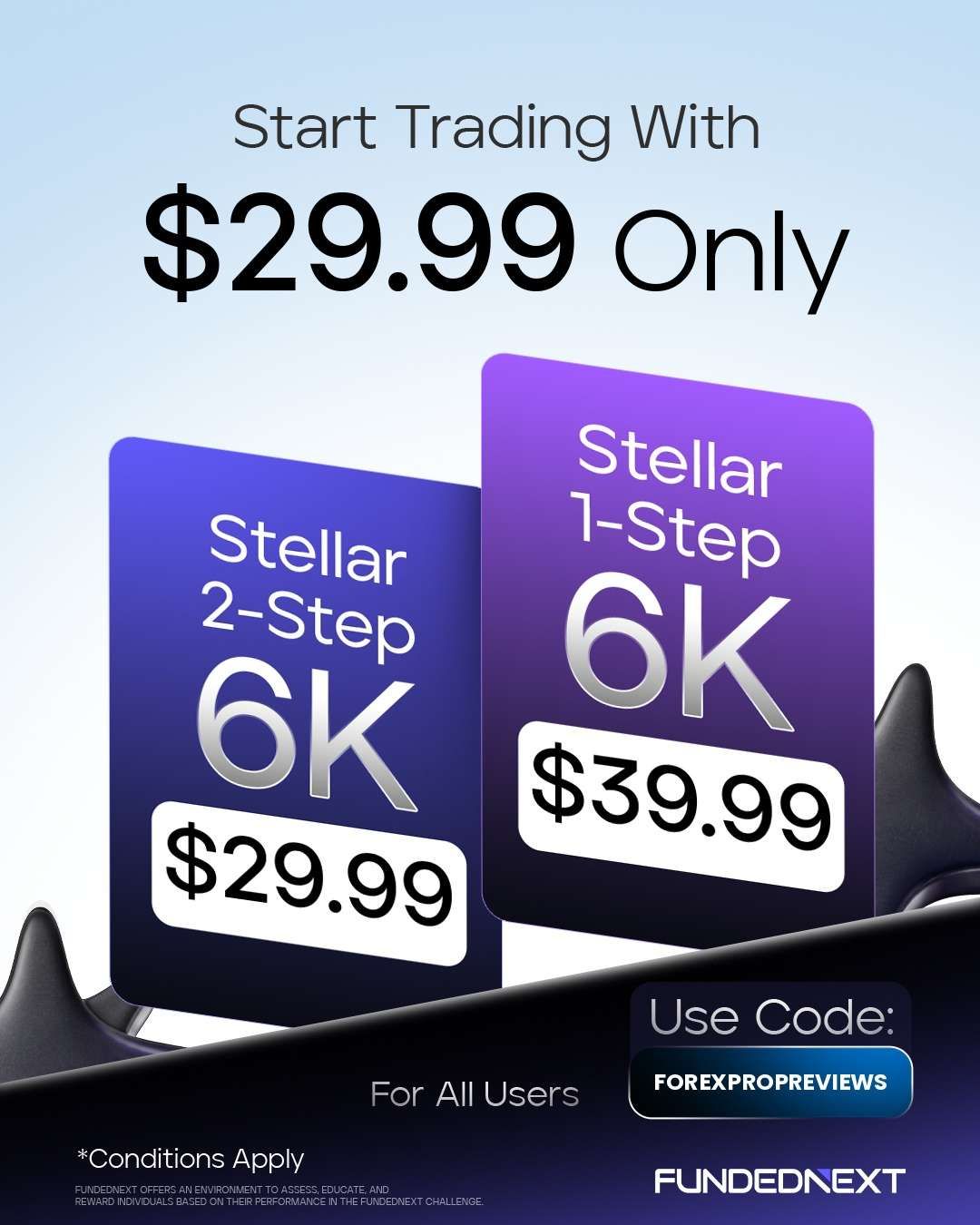

Traders looking for a lower-cost entry into proprietary trading can now access a new FundedNext 7% discount through Forex Prop Reviews. The code FOREXPROPREVIEWS applies to first purchases and also provides a 110% refund of the initial challenge fee, replacing the previous 120% refund offer.
The update changes the value proposition in an interesting way. While the headline refund percentage is slightly lower than before, traders now receive an immediate discount on the initial purchase as well. For traders already comparing challenge costs, that combination can make the upfront economics more attractive than a refund incentive alone.
FundedNext Introduces a 7% First-Purchase Discount
The new FPR offer is straightforward: traders making their first purchase can use FOREXPROPREVIEWS to receive 7% off their challenge.
The same code also provides a 110% refund of the initial challenge fee, subject to the applicable conditions of the offer. This means the promotion combines an upfront price reduction with a later fee-related incentive rather than relying entirely on one benefit.
That distinction matters because challenge pricing is one of the first barriers for traders entering a prop firm’s evaluation model. A discount reduces the amount of capital that has to leave the trader’s pocket immediately, while a refund mechanism potentially changes the effective cost after successfully progressing through the program.
From 120% to 110%: What Actually Changed?
The most obvious change is the reduction from the previous 120% refund to 110%.
At first glance, that looks like a weaker promotion. But looking only at the refund percentage misses the new 7% discount. The economics should instead be evaluated across the entire purchase cycle: what the trader pays initially, what they may recover later, and when that recovery becomes available.
This is particularly relevant because FundedNext’s standard refund mechanics are with successful progression rather than functioning as an unconditional cash-back arrangement. For its current CFD programs, the firm’s help documentation states that the refundable fee is generally with receiving Performance Rewards, with timing depending on the specific model. So, for example, Stellar 2-Step traders can request the refundable fee with their first Performance Reward, while Stellar 1-Step and Stellar Lite accounts purchased under the newer structure generally receive it with the third Performance Reward.
Why the Combination Matters for Challenge Economics
Prop trading promotions increasingly operate on two different psychological levers: reducing entry friction and increasing perceived recovery value.
The 7% discount addresses the first one. A trader who was already considering a particular account size pays less at checkout, which can make the decision easier without changing the underlying challenge rules.
The 110% refund addresses the second. Once traders think about the challenge fee as potentially recoverable, the psychological framing changes from “money spent on an evaluation” toward “an upfront cost that may be recovered after successful performance.”
That can influence which account traders choose. However, it should not encourage traders to increase their account size simply because the promotion reduces the fee. The challenge’s drawdown limits, profit targets, minimum trading requirements and payout structure remain more important than a relatively small change in entry cost.
The Funding Program Still Matters More Than the Promotion
FundedNext currently offers several account models, including the Stellar 2-Step, Stellar 1-Step, Stellar Lite and Stellar Instant programs. The differences between them are substantial, so the best use of the discount depends on the trader’s preferred evaluation structure rather than simply choosing the largest account available.
For example, the current Stellar 2-Step structure uses an 8% Phase 1 profit target and 5% Phase 2 target, alongside a 5% maximum daily loss and 10% maximum loss. The evaluation has no maximum trading period, although each phase carries a minimum trading-day requirement.
The Stellar 1-Step model takes a different approach, with a 10% profit target, 3% maximum daily loss, and 6% maximum loss. It also has a minimum trading requirement of two days.
Those differences illustrate why traders should calculate the promotion against the rules of the specific program. A cheaper challenge is not automatically a better challenge if its risk parameters do not fit the trader’s strategy.
Refund Incentives Can Affect Trader Retention
There is also a broader business reason why refund structures have become important in the prop trading model.
Once a trader has passed an evaluation and started generating Performance Rewards, recovering the original challenge fee gives them another reason to remain engaged with the account. The incentive is particularly meaningful because it is connected to successful trading activity rather than simply being handed back immediately.
FundedNext’s current documentation confirms that the standard refundable-fee mechanism is tied to funded performance and withdrawal eligibility. For Stellar 2-Step, the fee can be requested with the first Performance Reward, while newer Stellar 1-Step and Stellar Lite structures defer the reward until the third Performance Reward.
From a trader’s perspective, this makes the timing of the refund just as important as its percentage. A 110% refund that arrives after qualifying performance has a very different practical value from an immediate 110% cash rebate.
What Traders Should Check Before Using the Code
The promotion makes the initial purchase more cost-efficient, but traders should still evaluate the account using the same criteria they would apply without a discount.
First, check the maximum daily loss and overall loss limits. These determine how much room the strategy actually has before a breach. FundedNext’s current rules differ between Stellar models, with the 2-Step, 1-Step, and Stellar Lite accounts carrying different risk thresholds.
Second, look at the payout schedule and refund timing. A trader who prioritizes rapid access to profits may prefer a different model from someone who is primarily interested in lower entry costs and a longer evaluation window.
Finally, traders should not confuse the promotional refund with FundedNext’s general refund policy. The firm’s standard policy allows refunds in certain circumstances before trading begins, while fees generally become non-refundable once trading has commenced.
A More Cost-Efficient Entry, But Rules Still Come First
The new Forex Prop Reviews promotion gives FundedNext traders two immediate considerations: 7% off the first purchase and a 110% challenge-fee refund under the offer.
The reduction from the previous 120% refund means the headline reward is smaller, but the addition of an upfront discount changes the overall structure. For traders who were already planning to purchase a FundedNext challenge, lowering the initial cost while retaining a refund incentive can improve the effective economics of the journey.
The key is to treat the promotion as an enhancement to a suitable trading program, not as a reason to take a challenge that does not match your risk management. Challenge rules, drawdown mechanics, and payout conditions ultimately determine whether the account is workable.
Get the FundedNext Discount
Traders making their first FundedNext purchase can use FOREXPROPREVIEWS for 7% off, along with the 110% initial challenge-fee refund offered through Forex Prop Reviews.
Before purchasing, review the current account rules and select the funding model that fits your trading approach rather than simply chasing the promotional percentage. Use code: FOREXPROPREVIEWS
For a full breakdown of the firm’s programs, rules, pricing, and payout structure, see the FundedNext reviewfrom Forex Prop Reviews.