

Bullwaves Prime challenge programs give traders two distinct routes to a funded account: a faster 1-Step evaluation or a lower-cost 2-Step structure with more room between profit targets. That choice matters because the difference is not simply the number of phases. The two models also change the amount of profit a trader must generate, the risk parameters they work with, and how much they pay upfront.
The latest program presentation puts the entry price at $89 for the 5K 1-Step Challenge and $59 for the 5K 2-Step Challenge, with larger account sizes available as traders move up the range. Both models use MT5, offer 1:50 leverage, require at least 10 trading days, and advertise profit splits of up to 80%.
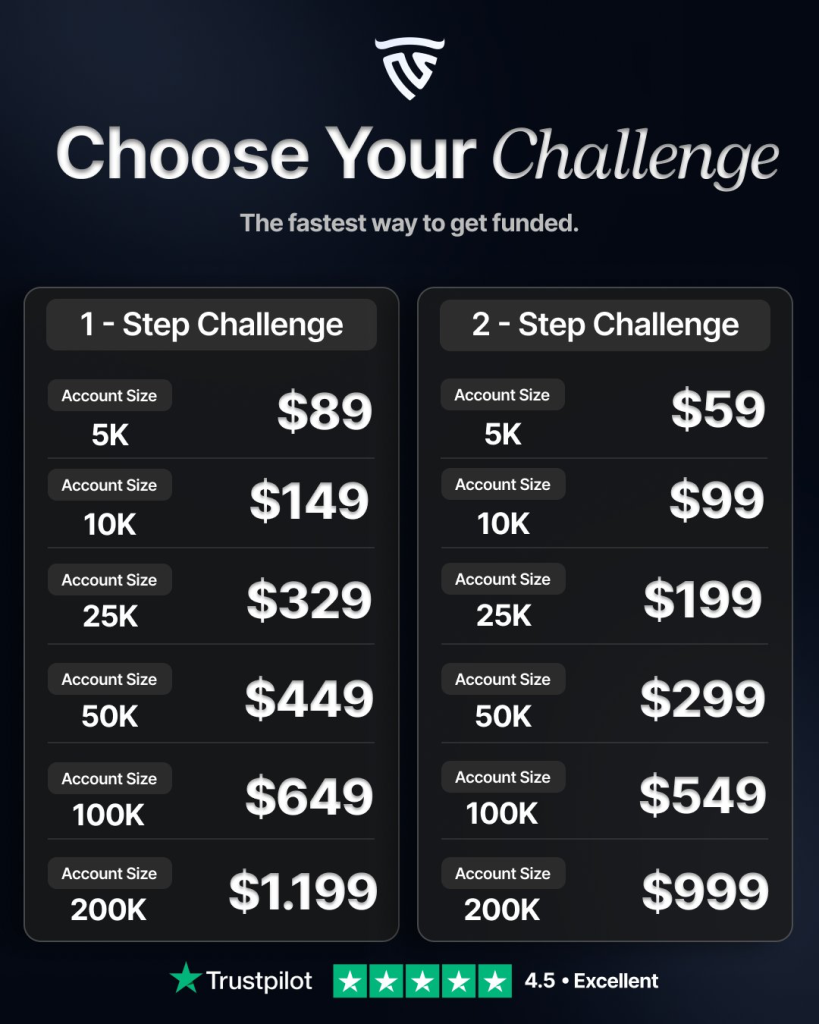
Bullwaves Prime Challenge Programs Offer Two Different Paths
The 1-Step Challenge is built around a single evaluation target of 10%. The 2-Step Challenge breaks the process into an 8% Phase 1 target followed by 5% in Phase 2. On paper, the second route looks slower, but that is not necessarily a disadvantage for traders who prefer a less concentrated evaluation.
The pricing difference is also meaningful. The current advertised prices are $89 for 5K, $149 for 10K, $329 for 25K, $449 for 50K, $649 for 100K, and $1,199 for 200K on the 1-Step model. The 2-Step starts lower at $59 for 5K, rising to $99 for 10K, $199 for 25K, $299 for 50K, $549 for 100K, and $999 for 200K.
That creates a clear strategic split: traders paying more for the 1-Step model are effectively paying for a shorter evaluation structure, while the 2-Step model reduces the initial fee in exchange for another hurdle before funding.
Bullwaves Prime 1-Step Challenge: Faster Evaluation, Tighter Risk
The 1-Step model is likely to appeal most to traders who already have a tested strategy and do not want to repeat essentially the same process across two evaluation phases.
The trade-off is the tighter risk framework. The program uses a 4% maximum daily loss and 8% maximum loss, alongside the 10% profit target. Reaching 10% while protecting an 8% maximum loss requires considerably more discipline than simply looking at the headline target.
The 10 minimum trading days requirement also prevents the one-phase structure from becoming an instant pass. Even if a trader reaches the profit target quickly, the account still has to satisfy the trading-day requirement before moving forward.
This is an important distinction for aggressive traders. A single strong session may produce a large portion of the required profit, but the evaluation structure is not designed to reward simply hitting the target as quickly as possible.
Bullwaves Prime 2-Step Challenge: Lower Entry Cost and More Room
The 2-Step Challenge takes a different approach. Phase 1 requires 8% profit, followed by another 5% target in Phase 2, while the risk parameters are set at 5% maximum daily loss and 10% maximum loss.
For traders who are more concerned with drawdown flexibility than evaluation speed, those wider loss parameters make the 2-Step model particularly interesting. The additional phase creates another checkpoint, but traders have more room to manage positions without operating as close to the account limits.
The lower price is another practical advantage. At the entry level, the 2-Step account costs $30 less than the comparable 1-Step account. That difference becomes more relevant for traders who are testing a strategy, experimenting with a prop firm’s execution environment, or simply want to limit the amount committed to an evaluation.
The 10-Day Requirement Changes How Traders Should Approach the Challenges
One of the more important details in the offer is the 10 minimum trading days requirement. Traders should not confuse the absence of a tight deadline with permission to trade without structure.
An unlimited evaluation period can benefit lower-frequency strategies. Swing traders and selective intraday traders do not have to manufacture setups simply because an evaluation deadline is approaching. That can reduce the temptation to increase position size or take marginal trades late in a challenge.
At the same time, the minimum-day rule creates another layer of discipline. A trader who reaches the target early still needs to satisfy the required trading activity, making the journey to funding more dependent on sustained execution rather than one unusually profitable sequence.
The announcement also highlights weekend trading, which could be useful for traders who hold positions beyond the traditional Friday close. Traders should still check the exact weekend-holding conditions attached to their selected account before relying on that feature.
Profit Splits and Payout Structure Matter After Funding
An 80% profit split is attractive at the headline level, but the more important question is how the payout rules interact with the account structure.
According to the firm’s program information, funded traders can receive an 80% profit split, with a 100% split available through an add-on on relevant programs. The published rules also include payout limitations, meaning traders should assess the withdrawal mechanics rather than judging the offer solely by its profit-share percentage.
The payout schedule matters for the same reason. Traders who generate profits but face restrictive withdrawal conditions may find that the headline profit split does not tell the full story.
For someone comparing several funding programs, the practical question is therefore not simply “Which firm pays the highest percentage?” It is “How easily can I turn profitable trading into an actual withdrawal?”
Consistency Rules Should Not Be Overlooked
The headline targets are only part of the challenge structure. Bullwaves Prime’s published program information also includes profit consistency and lot-size consistency requirements.
That can materially affect how traders approach both evaluations.
A strategy that relies on occasional outsized winners may produce the required return but still create problems under a consistency framework. Conversely, a trader who builds results through repeated, similarly sized positions may find the rules easier to accommodate.
This is why the cheaper 2-Step entry should not automatically be treated as the safer choice. The real fit depends on the trader’s distribution of returns, average position size, holding period, and tolerance for evaluation restrictions.
How the Two Models Fit Different Trading Styles
The simplest way to view the two challenges is to consider what the trader is actually paying for.
The 1-Step Challenge is primarily a time-saving proposition. The trader accepts a higher entry fee and tighter drawdown parameters to avoid a second evaluation phase. It makes more sense for traders who already have confidence in their strategy and prefer to reach the funded stage through a single performance hurdle.
The 2-Step Challenge is more focused on accessibility. The lower fee and wider drawdown parameters give traders a different risk profile, although the additional 5% Phase 2 target means there is another stage to complete before funding.
The difference becomes particularly relevant for traders with uneven performance. Someone who tends to make profits gradually may appreciate the 2-Step structure, while a trader capable of producing consistent returns within a controlled number of sessions may prefer the simplicity of 1-Step.
Scaling and Account Size Add Another Layer
Bullwaves Prime’s latest presentation states that the programs can scale up to $400,000, while the currently advertised challenge sizes extend to $200,000.
That distinction matters because traders should separate the size of the account available at purchase from the maximum capital that may become available through a scaling structure. A headline allocation figure does not necessarily mean a trader starts with that amount.
For traders planning to stay with a prop firm beyond the initial evaluation, scaling mechanics can therefore matter as much as the challenge price. The important questions are how account growth is triggered, what performance is required, and whether payout conditions change as the account expands.
Bullwaves Prime Is Selling Choice, Not One “Best” Challenge
The strongest aspect of these programs is not simply the headline pricing. It is the attempt to accommodate two different evaluation preferences within the same funding offering.
The 1-Step route targets traders who place a premium on reducing evaluation stages. The 2-Step route lowers the initial cost and spreads the performance requirement across two phases. Neither structure is automatically better; each shifts the pressure to a different part of the evaluation.
For traders comparing funding programs, that is the useful takeaway. Instead of choosing based only on account size or profit split, traders should map their strategy against profit targets, daily loss limits, overall drawdown, minimum trading days, consistency rules, payout limits, and withdrawal timing.
Bullwaves Prime’s two-model structure makes that comparison easier because the differences between the programs are clearly defined.
For traders considering either funding program, Forex Prop Reviews offers a 25% discount with the code FOREXPROPREVIEWS. The discount can make the already lower-priced 2-Step model particularly accessible, while also reducing the upfront cost of the 1-Step option.
Before purchasing, traders should review the complete Bullwaves Prime Review for challenge rules and payout conditions. The combination of challenge pricing, evaluation structure, drawdown rules, consistency requirements, and payout mechanics ultimately determines whether an account fits a particular trading approach.