
BestProp4U Two-Phase Challenge gives traders access to account sizes from $5,000 to $400,000, with a structure that puts the emphasis on hitting defined profit targets without strict trading-day requirements. For traders comparing prop firm funding programs, the combination of 1:50 leverage, no minimum or maximum trading days, and a 7% maximum loss makes the evaluation notably flexible.
The model also extends beyond the initial challenge. Once traders complete both phases, BestProp4U provides a funded account subject to the same core risk limits, while its scaling plan allows qualifying traders to build toward substantially larger allocations.
BestProp4U Two-Phase Challenge Explained
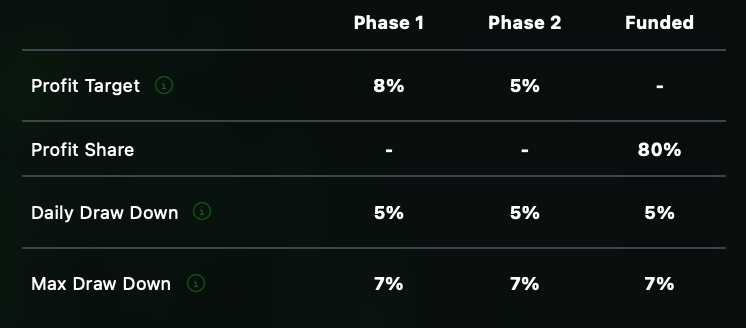
The first evaluation phase requires traders to generate an 8% profit target while staying within a 5% maximum daily loss and 7% maximum loss. There is no minimum number of trading days and no maximum time limit, meaning traders can approach the target according to their own strategy rather than increasing risk simply to finish within a deadline.
Phase two lowers the profit objective to 5%, while keeping the 5% daily loss and 7% maximum loss limits. Again, there are no minimum or maximum trading-day requirements.
This structure matters for traders whose strategies depend on selective entries. A swing trader, for example, does not have to manufacture trades simply to satisfy a minimum-days rule. Conversely, the absence of a deadline does not remove the need for discipline: the account can still fail quickly if daily or overall drawdown limits are breached.
What Happens After the Evaluation?
Completing both phases moves the trader into a funded account, where the primary restrictions are a 5% maximum daily loss and 7% maximum loss. The minimum withdrawal requirement is listed as 1% or $100, giving traders a clear threshold to consider when planning their first payout.
That payout threshold is operationally important. Traders often approach funded accounts differently once withdrawals become available, and a relatively low minimum can reduce the pressure to keep growing an account before taking money out. For risk-conscious traders, reaching a withdrawal threshold without chasing an outsized return can support a more conservative approach to account management.
The key point, however, is that the challenge’s flexibility does not translate into unrestricted risk. The 7% maximum loss remains the boundary throughout the funded stage, so position sizing and drawdown management remain central to the strategy.
A Scaling Plan Built Around Larger Allocations
BestProp4U’s scaling structure is one of the more ambitious parts of the program. Traders can hold up to $1 million in active evaluation accounts and another $1 million in funded accounts, provided there are no duplicate account sizes within the same plan type.
If a trader qualifies for multiple funded accounts of the same size, BestProp4U allows them to either merge those accounts into a larger account or activate them individually. That gives traders some control over how they deploy their allocation rather than forcing every account into a single configuration.
The firm also states that there is no compounding limit, allowing traders to scale beyond the initial allocation over time. For consistently profitable traders, this changes the attraction of the program: the challenge is not simply about obtaining a single funded account but potentially establishing a route toward significantly larger capital exposure.
Why No Trading-Day Requirement Matters
The absence of minimum and maximum trading days deserves more attention than it might initially receive. Many evaluation models can indirectly influence trader behavior because participants feel pressure to reach a target within a prescribed window or complete a certain number of days.
BestProp4U removes that particular constraint. Traders can wait for setups that fit their system instead of increasing activity merely to satisfy the calendar.
There is a psychological benefit as well. A trader who knows there is no countdown may be less inclined to overtrade after a losing position or increase risk to recover lost ground. That does not eliminate evaluation pressure, but it removes one common source of it.
The Real Test Is Drawdown Management
The profit targets are straightforward: 8% in phase one and 5% in phase two. The harder operational question is whether traders can pursue those returns while staying comfortably away from the 5% daily and 7% overall loss limits.
That distinction is important because a strategy can be profitable in the long run and still be poorly suited to a prop firm evaluation if its normal drawdowns are too large. Traders should therefore assess their historical risk profile against the firm’s limits before selecting an account size.
The availability of accounts up to $400,000 can also create a temptation to select a larger nominal balance simply because it offers more purchasing power. A larger account is only useful if the trader can operate within its drawdown parameters. Starting with an allocation that matches actual risk capacity may be more sustainable than maximizing the headline account size.
What Traders Should Consider Before Choosing an Account
The Two-Phase Challenge is particularly relevant for traders who value time flexibility, defined drawdown limits, and a path toward larger allocations. The lack of trading-day restrictions gives discretionary and swing-oriented traders more room to operate, while the scaling structure gives experienced traders a reason to remain with the program beyond the initial evaluation.
At the same time, traders should look beyond the headline account size. The practical value of a prop firm challenge comes from how comfortably a trader can operate within its loss limits, how the payout conditions fit their withdrawal strategy, and whether the scaling rules complement their longer-term approach.
For traders comparing funding programs, BestProp4U’s combination of flexible evaluation timing and an extended scaling pathway makes its Two-Phase Challenge worth examining on those operational criteria rather than simply comparing advertised account sizes.
Conclusion
BestProp4U’s Two-Phase Challenge combines 8% and 5% evaluation targets, 5% daily loss limits, a 7% maximum loss, 1:50 leverage, and no mandatory trading-day schedule. The funded stage then connects the evaluation to a scaling framework that can reach millions in cumulative allocation over time.
For traders who prefer to trade selectively and want a funding program with room to scale, the structure offers several practical advantages. The main consideration remains risk management: the absence of time pressure is useful only when paired with a strategy capable of respecting the firm’s drawdown boundaries.
Traders can review the BestProp4U Two-Phase Challenge and the BestProp4U review on Forex Prop Reviews before choosing an account. FPR Offers may also provide a discount code (FOREXPROPREVIEWS), where available, for traders looking to reduce the entry cost before starting an evaluation.