

The BestProp4U Futures Challenge introduces an evaluation model that combines structured risk management with milestone-based payouts before traders transition into a funded account. Rather than relying solely on a single evaluation target, the program incorporates consistency requirements, trailing drawdown rules, and staged reward payments that shape how participants approach both risk and position sizing.
BestProp4U Futures Challenge Rules Explained
For futures traders, those mechanics matter just as much as the profit target itself. Passing an evaluation is rarely about finding one exceptional trade. It is more often about maintaining disciplined execution while staying within predefined risk limits. BestProp4U’s framework reflects that philosophy by rewarding consistency over aggressive short-term performance.
BestProp4U Futures Challenge Structure
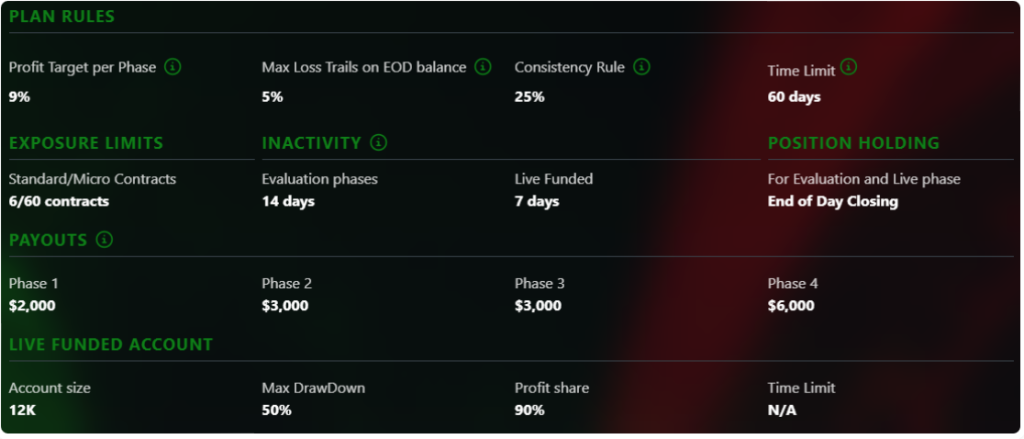
The evaluation requires traders to achieve a 9% profit target per phase while respecting a 5% maximum trailing loss based on the end-of-day balance.
Other core rules include:
- 9% profit target per evaluation phase
- 5% end-of-day trailing maximum loss
- 25% consistency rule
- 60-day evaluation time limit
- 14-day inactivity limit during evaluation
- 7-day inactivity limit after funding
- End-of-day position closing for both evaluation and funded accounts
Exposure limits are also defined according to contract type, allowing up to 6 standard contracts or 60 micro contracts, helping maintain proportional risk across different account sizes.
Milestone-Based Payout Schedule
One feature that distinguishes this challenge is its phased payout structure before traders reach the fully funded stage.
The payout schedule is divided into four milestones:
- Phase 1: $2,000
- Phase 2: $3,000
- Phase 3: $3,000
- Phase 4: $6,000
Once traders complete the process, they receive access to a $12,000 live funded account featuring:
- 90% profit split
- 50% maximum drawdown
- No time limit while funded
Breaking payouts into multiple milestones can create additional motivation throughout the evaluation journey. Rather than viewing funding as a single distant objective, traders encounter several measurable checkpoints along the way.
How the Consistency Rule Changes Trading Behavior
The 25% consistency rule deserves particular attention because it influences trading style more than many traders initially expect.
Consistency rules generally prevent a large percentage of total profits from coming from a single trading day. While traders can still have strong sessions, sustained performance becomes necessary to satisfy the evaluation.
Operationally, this encourages:
- More balanced daily returns
- Reduced reliance on one high-risk position
- Better capital preservation habits
- More repeatable execution across multiple trading sessions
For disciplined futures traders, these requirements often align with professional risk management practices already used in live markets.
Why the End-of-Day Trailing Drawdown Matters
Unlike static drawdown models, BestProp4U measures the maximum loss against the end-of-day account balance.
This distinction changes how traders protect open profits. As account equity increases, the allowable loss threshold trails the closing balance rather than remaining fixed from the starting balance.
Many experienced futures traders prefer understanding exactly how trailing drawdown behaves because it affects decisions such as scaling into positions, reducing overnight exposure, and protecting gains after profitable trading sessions.
Combined with mandatory end-of-day position closure, the framework encourages a disciplined intraday trading approach rather than prolonged exposure to overnight market gaps.
A Structured Evaluation Rather Than a Speed Contest
Some modern prop evaluations emphasize rapid progression with very few restrictions. Others introduce multiple safeguards intended to reduce erratic trading behavior.
The BestProp4U Futures Challenge sits closer to the second category.
The combination of a profit objective, consistency requirement, trailing drawdown, inactivity rules, and phased payouts creates an evaluation that rewards traders capable of maintaining steady performance over time. Participants who naturally follow trading plans and predefined risk parameters may find this structure more compatible with their existing routines than evaluations designed around fast account growth.
Positioning Within the Futures Prop Market
Across the futures prop industry, firms continue experimenting with different ways to balance trader flexibility against risk management. Some focus primarily on scaling opportunities, while others differentiate themselves through payout frequency, contract limits, or evaluation mechanics.
BestProp4U places more emphasis on structured progression. The phased payout schedule, clearly defined exposure limits, and funded account featuring a 90% profit split establish expectations from the beginning rather than leaving important operational details unclear. For traders comparing multiple evaluations, transparency around these mechanics can make it easier to determine whether the challenge fits their trading style.
Conclusion
The BestProp4U Futures Challenge is designed around controlled progression instead of aggressive risk-taking. Its combination of end-of-day trailing drawdown, a 25% consistency rule, phased payouts, and a 90% funded profit split creates an evaluation framework that rewards disciplined execution across multiple trading sessions rather than isolated standout performances.
Traders considering this evaluation should pay close attention to how the consistency rule and trailing drawdown interact with their existing strategy, as those mechanics will often have a greater impact on passing the challenge than the profit target alone.
Interested in learning more about BestProp4U? Visit the firm’s dedicated Review on Forex Prop Reviews for a full breakdown of its funding programs, account models, and trading conditions. You can also check the latest Forex Prop Reviews exclusive discount code (FOREXPROPREVIEWS) to reduce the cost of your next challenge purchase.