
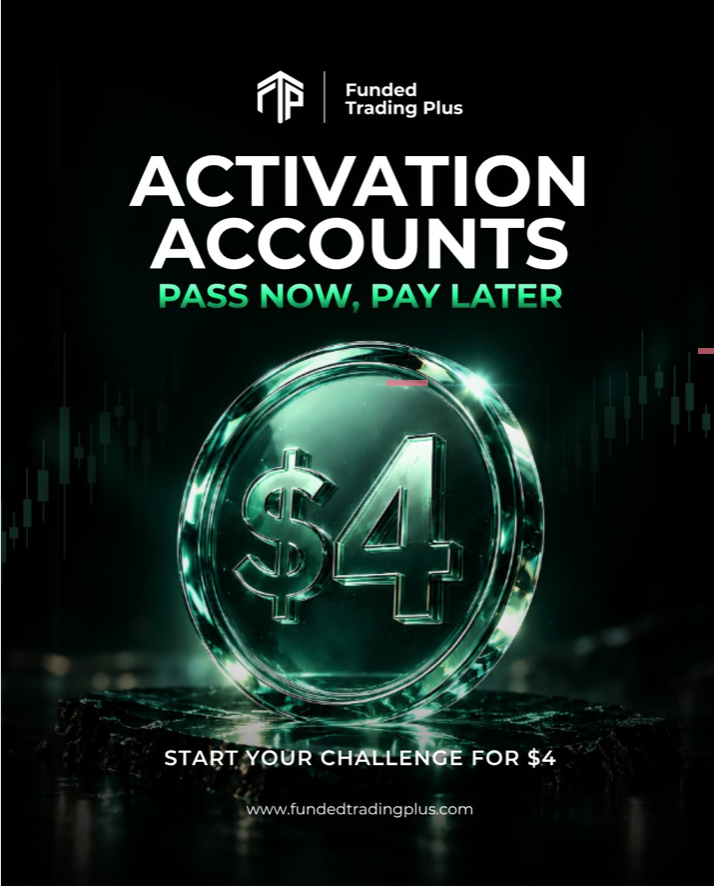
Funded Trading Plus is changing the economics of entering a prop trading challenge with its new $4 Activation Accounts, allowing traders to start an evaluation for just $4 and defer the larger payment until they actually pass. The model removes much of the upfront financial commitment attached to traditional challenges while keeping the evaluation itself deliberately short.
The new structure is particularly notable because the firm is not simply discounting an existing account. It separates the initial challenge cost from the eventual activation payment, creating a “pass now, pay later”funding model. Funded Trading Plus says the program is available across $25,000, $50,000 and $100,000 account sizes, with the same $4 starting payment for each.
Funded Trading Plus $4 Activation Accounts Introduce a Different Entry Model
The new Activation Accounts use a single-phase evaluation with a 2% profit target. Traders face no maximum trading period, no minimum trading-day requirement and, importantly, no consistency rule during the challenge.
Once the trader reaches the 2% target, they pay the remaining activation fee and receive a simulated funded account. If they fail the challenge instead, the initial $4 is the full amount they have paid toward that attempt. The accounts are available through MT5 and Match-Trader.
That distinction matters. The $4 should not be interpreted as the total price of a funded account for successful traders. It is the upfront portion of a two-stage payment structure, with the larger commitment only becoming due after qualification.
Why the $4 Entry Point Matters for Prop Traders
The most interesting part of this model is the shift in risk timing.
With a conventional challenge, traders pay the full evaluation fee before knowing whether they can satisfy the firm’s rules. Activation Accounts reverse that sequence. Funded Trading Plus is effectively asking traders to demonstrate that they can pass the evaluation before requiring the larger financial commitment.
For traders who frequently fail challenges, that changes the economics of experimentation. A failed attempt costs $4 rather than the full challenge price. That could make traders more willing to test a strategy or account size without treating every new evaluation as a significant upfront expense.
There is also a psychological element. A very low entry fee reduces the perceived barrier to starting, but the 2% target means the trader still has to produce the required performance before the larger payment becomes relevant. In other words, the offer lowers entry friction, rather than eliminating the performance hurdle.
The 2% Target Changes the Challenge Dynamic
A 2% profit target is substantially different from the larger targets found across many traditional evaluation structures. Combined with no time limit and no minimum trading days, the format gives traders considerable control over how quickly they attempt to reach the objective.
That flexibility could be particularly relevant for lower-frequency traders. A trader does not need to manufacture additional positions simply to satisfy a minimum-day requirement, while the absence of a consistency rule means a profitable trade does not automatically create a separate hurdle that must be balanced with additional trading.
However, the absence of those restrictions does not make risk management irrelevant. Traders still need to examine the complete Activation Account rules, particularly the drawdown conditions and the requirements that apply after passing. The firm’s help documentation explicitly states that Activation Accounts are a separate program rather than a replacement for its existing challenges.
A Potential Retention Mechanism, Not Just a Cheap Challenge
There is another commercial angle worth watching.
The $4 entry point can function as a low-cost customer acquisition mechanism. A trader who passes has already demonstrated engagement with the platform and strategy, making the subsequent activation payment a more natural next step than asking an untested customer to purchase a full challenge upfront.
This also creates a cleaner distinction between failed and successful traders. Those who do not pass lose only the initial $4, while successful traders become the group that generates the larger transaction. That structure can potentially reduce the psychological resistance associated with repeatedly purchasing evaluations.
For traders, the practical takeaway is slightly different: the low initial price should encourage closer attention to the post-pass economics. The important comparison is not simply “$4 versus a traditional challenge fee.” It is the total amount paid if successful, the funded-account rules attached to that payment, and the conditions governing eventual rewards.
Funded Trading Plus Adds Another Layer to Its Funding Range
The Activation Account launch also fits into a broader product range at Funded Trading Plus. Forex Prop Reviews’ current review describes the firm as offering one-step, two-step and instant-funding models, alongside features such as no minimum trading-day requirements and weekly payout structures on relevant programs.
Activation Accounts occupy a different position within that lineup. They retain an evaluation component, but the financial commitment is delayed until the trader clears it. That makes the product structurally different from both a conventional prepaid challenge and direct funding.
For traders deciding between account models, the key question is therefore not simply which program has the lowest advertised entry price. It is whether the payment structure, target, drawdown rules and funded-stage conditions match the trader’s actual approach.
What Traders Should Check Before Starting
The $4 starting cost is clearly the headline feature, but traders should look beyond the entry payment before committing to an Activation Account.
In particular, check the full activation fee that becomes payable after passing, the drawdown methodology, funded-account payout rules and any restrictions that apply after the evaluation. The firm’s own documentation stresses that Activation Accounts have their own rules and should not be assumed to operate identically to its other challenges.
The model is most strategically interesting for traders who value flexibility and want to limit the amount of capital committed before proving they can complete the evaluation. The absence of a time limit and minimum trading days further reduces pressure to trade simply for the sake of progressing.
Funded Trading Plus is therefore testing a relatively simple proposition: prove your ability first, commit more money second. Whether that structure represents better value ultimately depends on the activation cost and funded-stage conditions, but the $4 entry point makes the initial experiment considerably less expensive than paying a full challenge fee upfront.
Conclusion
The new Funded Trading Plus $4 Activation Accounts put the payment structure itself at the center of the product. Traders can choose a $25K, $50K or $100K account, pay $4 to begin, target 2% in a single phase and only pay the remaining activation fee if they pass.
That combination of a low upfront cost, no time limit, no minimum trading days and no consistency rule gives traders a different way to approach a prop evaluation. The main consideration is what comes after the 2% target: the activation fee and funded-account rules remain just as important as the unusually low entry price.
Looking to try Funded Trading Plus? Forex Prop Reviews offers the FOREXPROPREVIEWS discount code on eligible programs, along with its detailed Funded Trading Plus review.