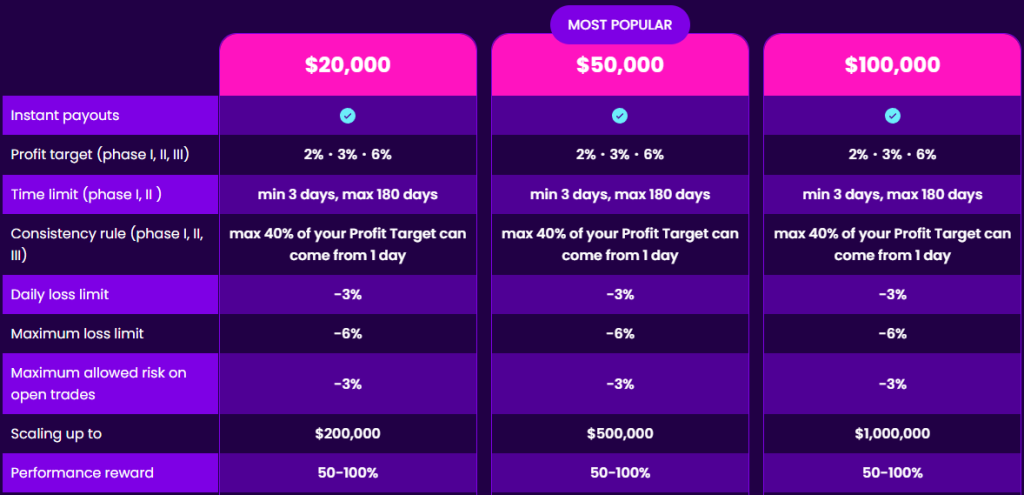
For traders who prefer lower profit targets over a fast evaluation, the Fintokei Start Trader program offers a notably different route to funded trading. Instead of demanding a large return in the opening phase, the model spreads the evaluation across three stages, with targets of 2%, 3%, and 6% and a 3% daily loss / 6% maximum loss framework.
That structure makes the program less about producing one aggressive winning run and more about demonstrating repeatable risk management. The trade-off is additional evaluation time: traders must complete three phases, each with its own minimum trading requirement and 180-day maximum period.
Fintokei Start Trader Account Sizes and Pricing
The Start Trader program currently offers three account sizes:
| Account Size | Price |
| $20,000 | $119 |
| $50,000 | $244 |
| $100,000 | $419 |
Traders can select funding in USD, EUR, JPY, or CZK, while leverage is available up to 1:25. The combination of relatively large account sizes and modest initial profit targets is one of the more interesting aspects of the model.
The $20,000 account, for example, requires only a 2% target in Phase 1, equivalent to $400 in simulated profit. That is a very different proposition from evaluation programs that immediately require traders to generate 8% or 10% while operating under comparatively tight drawdown limits.
How the Three-Phase Evaluation Works
The first phase requires traders to reach 2% profit without exceeding a 3% maximum daily loss or 6% maximum loss. Traders have up to 180 days to complete the phase and must trade for at least 3 calendar days.
Phase 2 increases the profit target to 3%, while the loss limits remain unchanged at 3% daily and 6% overall. Again, traders receive 180 days to complete the objective and need at least 3 calendar days of trading.
The final phase is where the return requirement becomes more substantial. Traders must generate 6% profit, while still respecting the same 3% daily and 6% maximum loss limits. The phase also comes with an 180-day deadline and a 3-calendar-day minimum.
Once all three phases are completed, the trader moves to a funded account. There is no minimum withdrawal requirement on the funded Start Trader account, according to the program information.
Why the Low Early Profit Targets Matter
The most interesting feature of Start Trader is not simply that it has three phases. It is the way the profit target is available to traders.
A trader does not need to make a large return immediately. Phase 1 asks for just 2%, followed by 3% in Phase 2. That can make the program better suited to traders whose strategies generate relatively small but repeatable returns rather than large bursts of performance.
There is a psychological benefit here as well. High initial targets can encourage traders to increase position sizes when they fall behind, creating exactly the kind of behavior that eventually causes a drawdown breach. A smaller first target gives a disciplined trader more room to let their strategy work instead of forcing trades simply to hit an evaluation number.
However, the three-phase structure should not be mistaken for an easy route to funding. The trader has to demonstrate consistency over a longer journey, and the final 6% target is still meaningful when paired with a 3% daily loss limit and 6% maximum loss.
The 180-Day Limit Changes the Trading Approach
Each Trader phase allows 180 days, which is a substantial amount of time compared with evaluation models designed around short-term performance.
For traders, that changes the optimal approach. There is little reason to treat the evaluation like a sprint when the program gives six months for each individual phase. A lower-risk strategy that produces steady returns can potentially be more appropriate than attempting to complete the target within a few trading sessions.
The 3-calendar-day minimum also prevents traders from completing a phase through a single concentrated trading period. This is a relatively small requirement compared with the 180-day window, but it reinforces the program’s emphasis on demonstrating performance across multiple sessions.
The Drawdown Rules Remain the Main Constraint
The low profit targets are attractive, but traders should pay close attention to the risk limits.
The Start Trader has a 3% maximum daily loss and 6% maximum loss throughout the evaluation. This means that a trader cannot simply use the generous time allowance to take oversized positions and wait for the market to recover.
In practical terms, the 6% maximum loss is the hard boundary around the entire evaluation. A strategy that routinely experiences large fluctuations may therefore be poorly matched to the account, even if its long-term profitability is strong.
This is where position sizing becomes particularly important. The program rewards traders who can separate their risk budget from their profit target rather than treating the target itself as a reason to increase exposure.
Funded Stage and Payout Considerations
After successfully completing all three evaluations, traders receive a funded Start Trader account without a minimum withdrawal requirement. The program information also states that the first payout becomes available after 14 calendar days, with subsequent withdrawals available on a bi-weekly basis.
The profit split for Start Trader is 50%, which is noticeably different from some of Fintokei’s other funding models. That is an important consideration when comparing the headline account size with the actual economics of the funded stage.
A $100,000 account may sound substantially more attractive than a smaller evaluation, but the account balance itself is not the same thing as earning potential. Traders should consider the combination of the entry price, probability of completing all three phases, drawdown allowance, and eventual profit share.
Start Trader’s Scaling Mechanism Adds a Longer-Term Incentive
Fintokei also provides a scaling plan for Start Trader. Traders who achieve 10% profit for at least two consecutive months can become eligible to move toward the next account size.
That requirement is strategically interesting because it shifts the focus beyond simply passing the evaluation. A trader who reaches funded status still has an incentive to preserve disciplined performance over multiple months rather than immediately maximizing risk.
From the firm’s perspective, scaling also creates a retention mechanism: traders who establish a repeatable track record have a pathway toward managing larger balances. For traders, the important distinction is that scaling is earned through sustained performance rather than simply completing the initial challenge.
How Start Trader Fits Into Fintokei’s Wider Funding Model
Fintokei does not rely on one evaluation structure. Its offering includes the Pro Trader, Start Trader, and Swift Trader programs, giving traders different routes depending on their preferred balance between evaluation complexity, profit targets, and payout economics.
Start Trader occupies the slower, lower-target end of that spectrum. Pro Trader uses a two-step evaluation with higher targets and larger drawdown allowances, while Swift Trader uses a one-step structure with a considerably higher target but a 100% profit split according to Forex Prop Reviews’ current review.
That makes Start Trader particularly relevant for traders who value a gradual evaluation more than minimizing the number of stages. It is not necessarily the best choice for someone who wants to reach a funded account as quickly as possible.
Is Fintokei Start Trader Worth Considering?
The strongest argument for Start Trader is the relationship between its low early profit targets and long evaluation windows. A trader does not have to manufacture aggressive returns immediately, and the 180-day period in each phase provides considerable flexibility around market conditions.
The weaker side is the additional complexity. Three evaluations mean three opportunities to make a mistake, and the eventual 50% profit split needs to be considered alongside the relatively accessible entry pricing. Traders should also make sure their normal risk model can comfortably operate inside the 3% daily and 6% overall loss limits.
For a trader with a patient strategy, the structure can make sense. Someone whose approach depends on high leverage, large position sizing, or rapid target-hitting may find the model considerably less attractive.
Fintokei Start Trader: What Traders Should Watch
The Start Trader program is ultimately built around a simple proposition: smaller performance targets early in the evaluation in exchange for a longer, three-stage path to funding.
That makes the program worth examining for traders who prioritize consistency and controlled risk. The account sizes reach $100,000, the evaluation targets begin at just 2%, and the 180-day limits reduce the need to force trades purely because of an approaching deadline.
For traders considering the program, the key question is not whether the profit targets look low in isolation. It is whether their existing strategy can produce those returns while staying comfortably inside the drawdown limits, and whether a 50% funded profit split fits their expectations once they qualify.
Fintokei Start Trader Discount
Forex Prop Reviews currently offers a 30% discount on Fintokei account purchases with the code FOREXPROPREVIEWS.
Before purchasing, traders can also review the full Fintokei assessment from Forex Prop Reviews for a broader look at its funding programs, trading rules, payout structure, and available account models. Read the full Fintokei review.