
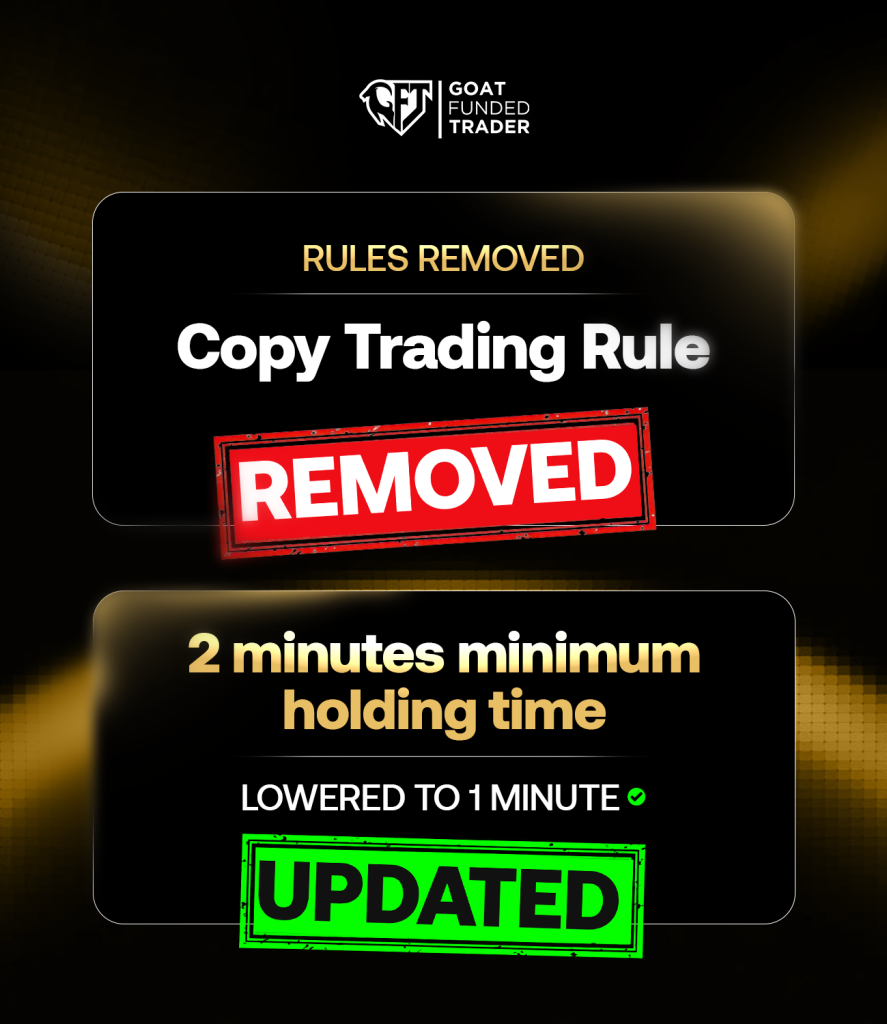
Goat Funded Trader has introduced two rule updates that directly affect how traders can operate its accounts. The Goat Funded Trader rule update reduces the minimum holding time from two minutes to one and, more significantly, allows traders to copy trades across their own GFT accounts.
Goat Funded Trader Updates: What Changed?
The first change cuts the minimum trade holding period in half. The requirement has moved from 2 minutes to 1 minute, giving eligible traders more flexibility when managing short-duration positions.
The change applies to new purchases only, meaning traders using accounts purchased before the update should check the applicable terms rather than assuming the revised rule applies retroactively.
The second change concerns copy trading. Goat Funded Trader now permits traders to copy positions between their own GFT accounts, including combinations of funded and challenge accounts.
Copy Trading Becomes More Flexible
Under the revised policy, traders can copy trades across their own accounts in several configurations: funded-to-funded, challenge-to-challenge, and challenge-to-funded.
That distinction matters operationally. A trader managing several GFT accounts can potentially use a single trading setup across those accounts rather than manually reproducing every position.
However, the rule remains account-owner specific. Copying another trader’s trades is still prohibited, as is copying between a GFT account and a personal broker account or another prop firm’s account.
For traders running multiple evaluations, this creates a more straightforward workflow. Instead of treating every challenge as an isolated trading environment, traders can coordinate positions across their own GFT accounts while remaining within the stated boundaries.
Why the One-Minute Holding Rule Matters
Reducing the minimum holding time to one minute is particularly relevant for traders whose strategies depend on fast entries and exits. The previous two-minute threshold could force some short-term setups to remain open longer than the strategy naturally required.
The change does not automatically make every strategy more viable. Traders still need to account for spreads, slippage, execution quality and the firm’s other risk rules. But removing one structural restriction gives short-term traders more room to execute their existing approach without artificially extending trade duration.
The fact that the change applies only to new purchases also creates an important distinction for traders deciding whether to open another account. The revised conditions may therefore become part of the purchasing decision rather than simply a benefit for the existing account base.
A Potential Retention Mechanism for Multi-Account Traders
The copy-trading change could have a broader commercial effect than the one-minute adjustment. Multi-account traders often face operational friction when they need to execute the same setup repeatedly across several accounts.
Allowing internal copying reduces that friction while keeping a clear boundary around third-party copying. It can also make the transition from challenge accounts to funded accounts more convenient, since the permitted combinations include challenge ↔ funded accounts.
From a trader-management perspective, that flexibility may make it easier to maintain a consistent execution process across multiple GFT accounts. It does not remove the need for risk management, however: copying the same position across several accounts can also multiply exposure if a trade moves against the strategy.
What Traders Should Check Before Using the New Rules
The revised rules create useful flexibility, but traders should distinguish between what is explicitly permitted and what remains restricted. Internal copying is allowed only between accounts belonging to the same trader, while external account copying remains outside the permitted framework.
Traders considering a new purchase should also pay attention to the effective scope of the one-minute holding requirement. Existing accounts may not automatically receive the revised condition, so checking the terms attached to the specific account is important before changing execution behavior.
For short-term traders, the combination of a lower holding-time threshold and internal account copying could make GFT’s challenge structure easier to operate. The practical benefit will depend on how well those rules fit the trader’s strategy, risk limits, and account-management approach.
Goat Funded Trader Positioning
The latest changes focus less on headline account pricing and more on reducing trading restrictions. That is strategically relevant because operational rules can have a direct impact on whether a trader’s existing strategy fits an evaluation model.
For traders already considering multiple GFT accounts, the internal copy-trading permission is arguably the more consequential change. The one-minute threshold addresses execution flexibility, while the copy rule addresses account-management efficiency.
Forex Prop Reviews readers can review the firm’s current offering and account conditions before making a purchase by clicking HERE. FPR also offers a Goat Funded Trader discount code (FOREXPROPREVIEWS), providing an additional consideration for traders comparing the overall cost of entering a funding program.