



The Blue Guardian Pro Two-Step Challenge gives traders access to account sizes from $5,000 to $200,000, combining a conventional two-phase evaluation with relatively flexible time limits. The structure is particularly relevant for traders who prefer to build performance gradually rather than operate under a fixed deadline.
Unlike some evaluation models that pressure traders to reach targets within a set number of days, Blue Guardian removes the maximum trading-period constraint in both phases. That changes the practical risk profile of the challenge: traders can focus more on staying within the drawdown limits and less on accelerating returns simply because the clock is running.
How the Blue Guardian Pro Two-Step Challenge Works
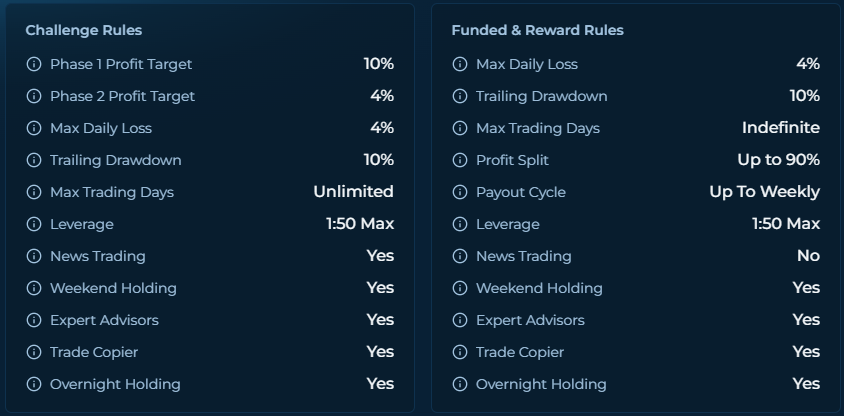
The program is divided into Phase 1 and Phase 2, with different profit objectives but the same core loss parameters.
In Phase 1, traders need to reach a 10% profit target while respecting a 4% maximum daily loss and 10% maximum trailing loss. There is no maximum trading period, but traders must complete at least four trading days, with each day generating a minimum 0.5% profit.
Phase 2 lowers the profit target to 4%. The 4% daily loss and 10% trailing loss limits remain in place, while traders again need at least four trading days, each producing at least 0.5% profit. There is also no maximum time limit for completing the second phase.
Once both stages are successfully completed, traders move to a funded account. The funded stage retains the 4% maximum daily loss and 10% maximum trailing loss requirements, while withdrawals have a $100 minimum requirement.
No Time Limit Changes the Trader’s Strategy
The absence of a maximum trading period is one of the more consequential features of this account model.
A fixed deadline can encourage traders to increase position sizes or take marginal setups because failing to reach the target in time effectively ends the evaluation. Blue Guardian’s open-ended timeframe removes that particular source of pressure. A trader can theoretically wait for higher-quality setups instead of treating every trading session as an opportunity that must contribute toward the target.
There is, however, an important distinction between having unlimited time and having unlimited freedom. The 0.5% minimum profit requirement on each of the four trading days introduces a consistency element. Traders cannot simply reach the target through one large winning trade and immediately move through the evaluation without demonstrating activity across multiple qualifying days.
That requirement may favor traders whose strategies naturally produce relatively repeatable daily returns. It could be less convenient for swing traders who routinely hold positions for several days and do not generate frequent closed profits.
Drawdown Rules Remain the Main Risk Constraint
The headline account size can be attractive, but the actual operating parameters matter more than the notional funding amount.
A 4% maximum daily loss creates a relatively narrow daily risk budget, particularly for traders using high leverage. With leverage of up to 1:50, the available buying power can support substantial positions, but the drawdown rules ultimately determine how aggressively that leverage can be used.
The 10% trailing loss also deserves attention. Because the loss limit trails performance, traders need to understand how their account’s drawdown is calculated and how profits affect the effective risk buffer before adopting an aggressive position-sizing approach.
For experienced traders, this makes risk management more important than simply hitting the 10% Phase 1 target. A strategy that reaches the target quickly but repeatedly approaches the loss limits may be less suitable for the model than one producing slower, controlled returns.
The Two-Phase Structure Creates a Different Incentive
The reduction from a 10% Phase 1 target to 4% in Phase 2 creates an interesting progression.
Phase 1 represents the more demanding performance hurdle, while Phase 2 shifts the emphasis toward confirming that the trader can continue producing returns without taking excessive risk. The second phase therefore acts less like another full challenge and more like a shorter validation period.
From a trader-retention perspective, that matters. Once a trader has completed the first stage, the remaining profit objective is comparatively modest. The psychological incentive is to preserve the account rather than chase another large return target, provided the trader maintains discipline around the drawdown rules.
The four-day minimum in each phase reinforces this. The program does not simply reward a single high-risk outcome; traders have to produce qualifying results across multiple trading days.
Account Sizes From $5,000 to $200,000
The range of $5,000 to $200,000 gives traders room to select an account according to their preferred risk and capital requirements.
For newer prop traders, the smaller account sizes can provide a way to test whether their strategy fits the firm’s rules without immediately committing to the largest available evaluation. More experienced traders may instead look toward the larger accounts, where the same percentage-based targets translate into substantially larger nominal profit objectives.
The important point is that a larger account does not make the percentage-based challenge easier. A 10% target remains 10%, while the 4% daily loss and 10% trailing loss also scale with the account balance. Traders therefore need to evaluate the program based on their strategy’s percentage returns and risk characteristics rather than the headline dollar figure.
What Traders Should Consider Before Choosing the Program
The Pro Two-Step model is best suited to traders who value time flexibility and structured risk limits.
The absence of a maximum trading period can be particularly useful for systematic traders or those whose strategies depend on waiting for specific market conditions. At the same time, the four qualifying days per phase mean traders still need to plan around the 0.5% daily profit requirement.
The biggest operational consideration is therefore not how quickly the account can be passed, but whether the trader’s normal strategy can produce the required returns while staying comfortably away from the drawdown boundaries.
The $100 minimum withdrawal requirement is another detail worth checking when planning the funded stage. Traders should consider their expected profit levels, withdrawal frequency, and personal risk tolerance rather than treating the funding stage as simply the final step of the evaluation.
Blue Guardian’s Pro Two-Step Challenge in Context
Across the prop trading industry, two-step evaluations remain popular because they separate the initial performance hurdle from a shorter confirmation phase. Blue Guardian’s version follows that familiar structure but combines it with no maximum trading period, leverage of up to 1:50, and account sizes reaching $200,000.
That combination makes the challenge less dependent on speed. The trade-off is that traders still face strict percentage-based drawdown limits and minimum daily performance requirements, so the flexibility should not be confused with a relaxed risk framework.
For traders who already have a tested strategy, the model offers a relatively clear framework: reach 10% in Phase 1, then 4% in Phase 2, satisfy the four-day requirements in each stage, and continue managing the same core drawdown constraints after funding.
Conclusion
The Blue Guardian Pro Two-Step Challenge stands out primarily because it gives traders time to execute rather than forcing them to race toward a target. That can materially change how a disciplined trader approaches the evaluation, especially when combined with the lower Phase 2 target.
Still, the challenge is not simply about patience. The 4% daily loss, 10% trailing loss, and 0.5% minimum profit on qualifying days create meaningful constraints that traders should model against their existing strategy before purchasing an evaluation.
For traders considering the program, the most useful question is not whether they can make 10%. It is whether they can make 10% without changing the way they normally manage risk.
Looking to evaluate the program? Check the Blue Guardian review on Forex Prop Reviews for more details on the firm and its funding options. Also, use our Discount Code (FOREXPROPREVIEWS) for a 35% Discount.