

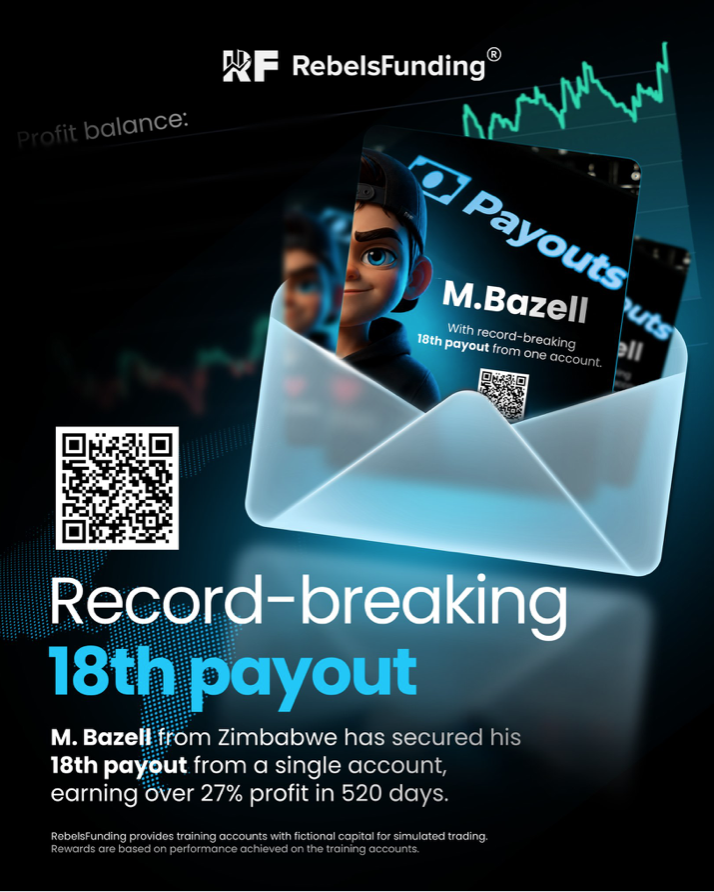
A RebelsFunding 18th payout is a useful reminder that prop trading does not necessarily have to revolve around passing an evaluation quickly and withdrawing once. A trader from Zimbabwe, identified by the firm as M. Bazell, has reportedly kept the same account for 520 days, generated more than 27% profit, and reached his 18th payout.
That matters because longevity changes the economics of a funded account. Instead of treating the account as a short-term challenge to conquer, the trader has effectively used it as a longer-term vehicle for extracting profits while preserving access to the account.
RebelsFunding trader reaches 18th payout
According to RebelsFunding, M. Bazell has traded the same account for 520 days and has now secured his 18th payout. The firm says the account generated more than 27% profit during that period.
The accompanying trading statistics also point toward a relatively low win-rate approach. The account shown has a 32.73% success rate, while the reported profit factor stands at 1.23. That combination is important: a trader does not necessarily need to win most trades if the winners are sufficiently larger than the losses and risk remains controlled.
The account data shows 1,054 positions, with total winning trades generating $13,155.97 against $10,657.19 in losing trades. The reported average risk-to-reward ratio is 1:2.54, reinforcing the idea that the strategy is relying more on payoff asymmetry than a high percentage of winning trades.
RebelsFunding 18th payout shows why account survival matters
The most interesting part of the update is arguably not the number 18. It is the 520-day holding period behind it.
Many traders approach prop evaluations with a finish-line mentality. Once a profit target is reached, the objective becomes getting funded; once funded, the next psychological milestone becomes the first withdrawal. That mindset can encourage traders to take unnecessary risk because every stage feels like something that needs to be completed quickly.
A long-lived account presents a different incentive structure. If the trader already has a functioning funded account, preserving that account can be more valuable than attempting to maximize returns over a short period. A modest return repeated across multiple payout cycles can produce a meaningful cumulative result without requiring the trader to repeatedly purchase and pass new challenges.
That distinction is particularly relevant when evaluating funding programs. The headline profit split or account size gets most of the attention, but payout frequency, drawdown rules and the ability to keep trading after a withdrawal can be just as important to a trader’s long-term economics.
Payout systems can change trader behavior
RebelsFunding currently offers several funding routes, ranging from multi-step evaluations to its Diamond direct-funding model. Its reviewed programs include account sizes from $1,000 to $320,000, while funded traders can receive profit shares of up to 90%, depending on the program and progression.
The firm also advertises a first payout after 14 calendar days for several of its evaluation-based programs, followed by bi-weekly withdrawals.
That structure creates a potentially important behavioral difference. Traders who know there is a defined path to recurring withdrawals have less reason to treat every profitable position as an opportunity to push for an outsized account jump. The account itself becomes an asset worth protecting.
The Bazell example illustrates the point without requiring extraordinary headline returns. More than 27% over 520 days is a very different proposition from attempting to make 27% in a few weeks. The former emphasizes survival, repeatability and payout extraction; the latter can encourage significantly more aggressive exposure.
A low win rate is not automatically a problem
The trading statistics attached to the update provide another useful lesson for traders assessing performance.
A 32.73% win rate can look uncomfortable at first glance, particularly to newer traders who associate profitability with winning more than half of their trades. But the other figures provide important context. With an average RRR of 1:2.54, the strategy can tolerate a substantial number of losing trades while remaining profitable.
The reported 1.23 profit factor also indicates that gross winning performance has exceeded gross losing performance over the tracked sample.
That does not make the strategy universally suitable, nor does one account prove that the approach will remain profitable indefinitely. It does, however, demonstrate why traders should assess funded-account performance using several metrics rather than focusing on win rate alone.
For prop traders, this becomes even more important because the relevant question is not simply whether a strategy makes money. It is whether the strategy can do so without breaching the firm’s daily or overall drawdown limits.
Long-term funded accounts change the value proposition
The broader implication for RebelsFunding traders is that account longevity can be an overlooked part of program selection.
A challenge with an attractive entry price may look appealing if the only objective is to reach funded status. But if the trader repeatedly loses accounts after funding, the initial affordability becomes less meaningful. Conversely, an account that remains active through multiple payout cycles can potentially reduce the need to continually restart the evaluation process.
This is where scaling and payout mechanics matter. RebelsFunding’s programs include scaling structures that can increase account size over time when traders meet their respective performance conditions.
The incentives therefore extend beyond simply passing a challenge. Traders who can maintain disciplined exposure have a reason to think in months rather than days, particularly when the program permits recurring withdrawals and continued trading.
For traders considering RebelsFunding, the practical takeaway is to study the complete account lifecycle: evaluation targets, daily and maximum loss limits, minimum trade requirements, payout conditions, profit split and scaling rules. A low-cost challenge is only one part of the calculation.
What traders can take from the 18th payout
The 18th payout is significant because it demonstrates a different way of approaching prop funding. The strongest outcome for some traders may not be a rapid account flip or a spectacular single withdrawal, but keeping a funded account alive long enough for multiple smaller payouts to compound.
That requires a different psychology. Once an account has produced several withdrawals, protecting future payout opportunities can become more important than chasing another large percentage gain.
For prospective traders, Bazell’s reported 520-day run is therefore less about copying his strategy and more about understanding the underlying principle: a funded account only has recurring value while it remains alive and within the firm’s rules.
RebelsFunding’s latest trader spotlight puts that principle into unusually concrete terms, 18 payouts from the same account, rather than 18 separate attempts to get funded.
Traders considering the firm’s funding programs can use the FOREXPROPREVIEWS discount code for 15% off RebelsFunding accounts.
For a full breakdown of account types, trading rules, pricing, payout conditions and available funding models, see the RebelsFunding review on Forex Prop Reviews.