FundedNext has rolled out a new FundedNext leverage update that increases leverage on indices and commodities across its Stellar account models, reversing the tighter risk conditions introduced earlier this year during periods of elevated market volatility.
The adjustment takes effect from May 18, 2026, and applies not only to new challenge purchases but also to all active accounts already running under the firm’s ecosystem. That detail matters more than it may initially appear. Many prop firms quietly reserve structural upgrades for future purchases, forcing existing traders to rebuy evaluations to access better conditions. FundedNext avoided that route here.
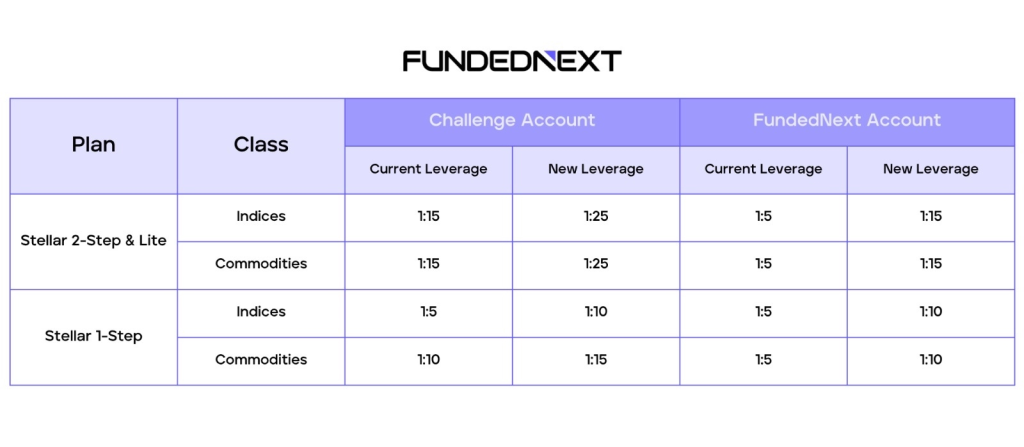
FundedNext Update: Indices and Commodities Leverage
For traders operating index-heavy systems on instruments like NASDAQ, US30, or DAX, the change materially alters position flexibility, margin efficiency, and drawdown management inside both evaluation and funded environments.
What Changed in the FundedNext Leverage Update?
The leverage increase affects the firm’s Stellar 1-Step, Stellar 2-Step, and Stellar Lite models.
Stellar 2-Step & Lite Accounts
- Indices
- Challenge: 1:15 → 1:25
- Funded Accounts: 1:5 → 1:15
- Commodities
- Challenge: 1:15 → 1:25
- Funded Accounts: 1:5 → 1:15
Stellar 1-Step Accounts
- Indices
- Challenge: 1:5 → 1:10
- Funded Accounts: 1:5 → 1:10
- Commodities
- Challenge: 1:10 → 1:15
- Funded Accounts: 1:5 → 1:10
According to the firm, the earlier leverage reductions were introduced during heightened geopolitical instability and unusually volatile trading conditions. With volatility conditions easing across broader markets, FundedNextis now restoring more aggressive exposure limits.
Why This Matters Beyond Simple Buying Power
In the prop trading space, leverage changes are rarely just cosmetic adjustments. They directly influence how traders structure risk, especially for firms using static drawdown models.
Lower leverage forces traders to either reduce position size or hold more margin against open trades. For scalpers and intraday index traders, that often means fewer simultaneous positions, tighter execution flexibility, and slower capital deployment during high-probability setups.
The jump from 1:5 to 1:15 on funded index accounts under the Stellar 2-Step and Lite structures is particularly meaningful. It gives funded traders more operational room without changing the underlying drawdown parameters. That combination tends to appeal to experienced traders who already manage risk conservatively but want greater flexibility during volatile intraday sessions.
At the same time, higher leverage increases psychological pressure for newer traders. Prop firms understand this balance well. More leverage can improve challenge accessibility for disciplined traders, but it also tends to accelerate account breaches among undisciplined participants. That dynamic is central to modern prop firm economics.
A Calculated Move for Trader Retention
One overlooked aspect of this update is timing.
Over the past several months, many prop firms tightened trading conditions as index volatility surged around geopolitical tensions, central bank uncertainty, and abrupt macro-driven price swings. Some firms reduced leverage temporarily. Others quietly restricted lot sizing or widened internal risk controls.
Now that volatility conditions have normalized relative to earlier 2026 spikes, firms are gradually reopening risk parameters to retain active traders and improve platform attractiveness.
FundedNext appears to be positioning this adjustment as both a trader-friendly restoration and a retention mechanism. Extending the changes to currently running accounts removes friction for existing users and reduces the feeling that legacy accounts are operating under inferior conditions.
That matters in a sector where traders regularly compare firms based on:
- leverage availability,
- consistency rules,
- payout speed,
- scaling structures,
- and account usability during real market conditions.
The Difference Between Evaluation Leverage and Funded Leverage
One detail worth noting is the separation between challenge leverage and funded leverage.
Many firms offer aggressive leverage during evaluations, but scale it down sharply once traders reach funded status. FundedNext still maintains lower leverage on funded accounts compared to challenge phases, but the gap has narrowed considerably under this update.
That change could improve strategy continuity.
For traders running systems optimized during evaluations, a dramatic leverage reduction after funding often forces major adjustments to execution style and trade sizing. Narrowing that disparity helps traders transition more smoothly between phases without rebuilding their entire risk model.
This is especially relevant for indices traders whose systems rely on rapid intraday exposure rather than longer-term swing positioning.
Commodities Traders Also Benefit
The commodities side of the update should not be ignored.
Gold traders in particular have dealt with volatile margin conditions across the prop industry throughout the past year. Instruments like XAUUSD can produce sharp intraday swings that become difficult to manage under restricted leverage environments.
By increasing commodities leverage across Stellar models, FundedNext is effectively reopening flexibility for traders using short-duration gold strategies, breakout systems, or session-based momentum setups.
That may increase the appeal of the firm among traders who specialize in metals rather than forex majors.
What Traders Should Consider Before Scaling Exposure
Higher leverage improves flexibility, but it also magnifies execution mistakes.
Traders moving from 1:5 to 1:15 funded leverage may feel tempted to scale aggressively simply because margin requirements have eased. In practice, disciplined risk allocation still matters more than raw buying power.
The operational advantage here is less about taking oversized positions and more about improving trade management efficiency:
- holding multiple correlated positions,
- reducing margin strain during volatility,
- and avoiding premature position closures due to limited usable margin.
Experienced traders typically use leverage as a flexibility tool rather than a reason to increase risk recklessly.
Conclusion
This leverage adjustment signals that FundedNext is becoming more comfortable with current market conditions after months of defensive risk management across the prop sector.
The update also reflects a broader industry shift back toward trader-friendly flexibility after a period where firms prioritized capital protection over usability. By applying the changes to existing accounts instead of restricting them to new purchases, FundedNext strengthens the practical value of its Stellar ecosystem without forcing traders into repurchases or migrations.
For active indices and commodities traders, the change materially improves account usability, especially for strategies that rely on intraday execution speed and efficient margin deployment.
If you are considering a Stellar challenge, you can also check the latest FundedNext Review and use our Refund Code (FOREXPROPREVIEWS) for a Massive 120% Refund.